The Craft of Rope and Binding Materials: The Invisible Strength of Javanese Architecture

javadiscovery.com – In the high, mist-shrouded bamboo forests of Mount Merapi, the craft of rope and binding materials begins with the selection of a single, mature “apus” bamboo culm. To the untrained eye, it is merely a stalk of grass, but to the Javanese “tukang” (artisan), it is a source of “tali”—the flexible sinew that holds the village together. The craft of rope and binding materials is the silent foundation of Javanese vernacular engineering, a sophisticated system of joinery that relies on tension, friction, and organic fibers rather than the rigid finality of iron nails. In a land prone to the sudden “lindhu” (earthquake), these flexible bindings allow a house to “move” with the earth, absorbing energy that would shatter a brittle, modern structure. The craft of rope and binding materials is a testament to the Javanese philosophy of “nrimo” (acceptance) and “luwes” (flexibility), where the strength of a connection is found not in its hardness, but in its ability to yield and tighten under pressure. From the dark, waterproof fibers of the “ijuk” palm to the supple strips of rattan, these materials are the literal threads that weave the physical landscape of Java into a resilient, living tapestry.
Ijuk: The Immortal Fiber of the Volcano
To understand the local reliance on the craft of rope and binding materials, one must first look at “ijuk.” These are the black, horsehair-like fibers found at the base of the “aren” (sugar palm) leaves. Ijuk is perhaps the most prestigious material in the craft of rope and binding materials due to its extraordinary resistance to rot, moisture, and even fire. In the wet tropical climate of Java, where untreated hemp or cotton would dissolve in a single monsoon season, ijuk remains “abadi” (eternal). It is the material of choice for the most sacred structures, including the multi-tiered “meru” roofs of ancient shrines and the structural lashings of the “joglo” palace houses.
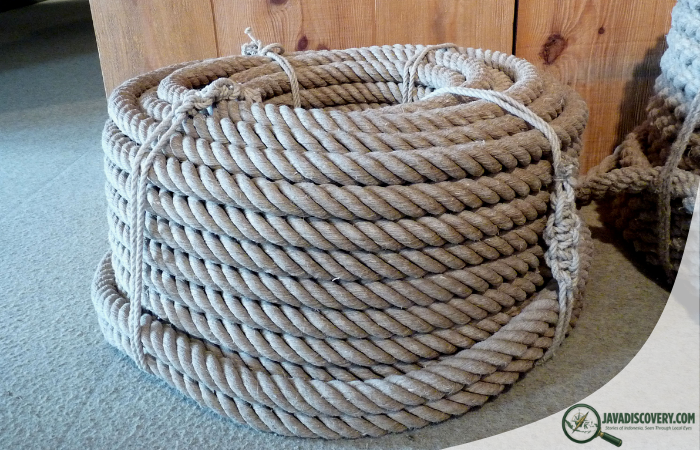
The processing of ijuk is a labor of “ketelitian” (meticulousness). The raw fibers must be combed to remove debris, graded by thickness, and then twisted by hand into “tali ijuk.” Because the fiber is naturally stiff and slightly abrasive, the craft of rope and binding materials using ijuk requires a specific “roso” or feel; the weaver must know exactly how much tension to apply so the rope does not snap during the twisting process. Once completed, an ijuk lashing is virtually indestructible. It is often said in Javanese villages that the ijuk rope will outlast the wood it binds, a silent witness to the generations that pass beneath the rafters it holds aloft.

Local voices in the rural highlands of Tasikmalaya describe ijuk as the “rambut bumi” (hair of the earth). An old craftsman, his fingers stained dark by the palm resin, explains that ijuk is “dingin” (cool) and does not “makan kayu” (eat the wood) the way iron nails do. The craft of rope and binding materials acknowledges that metal rusts and expands, eventually cracking the timber, whereas ijuk and wood age together in a state of “manunggal” (unity). This deep understanding of material compatibility is the core of Javanese sustainable architecture, ensuring that the house remains a healthy, breathing entity for centuries.
Bamboo and Rattan: The Supple Sinews
While ijuk provides the heavy-duty longevity, the craft of rope and binding materials for daily village life relies heavily on “bambu” and “rotan” (rattan). The “tali bambu” is created by slicing the outer skin of the bamboo—the “kulit”—into paper-thin, ribbon-like strips. These strips are incredibly strong in tension and, when soaked in water, become as flexible as leather. The craft of rope and binding materials using bamboo is a skill every Javanese child traditionally learned, as it is the primary method for securing “pagar” (fences), “kandang” (livestock pens), and the “rangka” (framework) of smaller village dwellings.
Rattan represents the “alus” (refined) side of the craft of rope and binding materials. Because rattan is a climbing palm, its fibers are naturally long and continuous, making it ideal for the intricate “anyaman” (weaving) lashings found in Javanese furniture and the decorative joints of the “pendopo” (open pavilion). The craft of rope and binding materials with rattan often involves a technique called “simpul mati” or “simpul hidup,” depending on whether the joint needs to be permanent or adjustable. The beauty of a rattan lashing lies in its “kerapihan” (neatness); a master craftsman can hide the beginning and end of a rope so perfectly that the joint appears to have grown naturally from the wood.
The significance of these materials in the craft of rope and binding materials is also seasonal. Bamboo lashings are often replaced after the harvest, a ritual of “pembersihan” (cleansing) that ensures the farm structures are ready for the coming rains. This cycle of maintenance is not seen as a burden but as a way of staying “eling” (mindful) of one’s surroundings. The craft of rope and binding materials keeps the farmer in constant physical contact with his environment, reinforcing the Javanese belief that a home is not a static object, but a dynamic relationship between the human hand and the gifts of the forest.
The Geometry of the Knot: Spiritual Tension
In the Javanese worldview, the craft of rope and binding materials is not merely a mechanical task; it is a spiritual one. The way a knot is tied—the “simpul”—carries symbolic weight. A knot is a “pertanda” (sign) of a commitment or a promise. In traditional Javanese weddings, the “temu manten” ceremony often involves the symbolic binding of the couple’s hands or clothing, a ritual application of the craft of rope and binding materials to the social fabric. The knot must be strong enough to hold, yet “luwes” enough to allow for growth.
This spiritual dimension is visible in the structural lashings of the “saka guru” (the four main pillars of a Javanese house). These joints are often wrapped in a specific pattern of ijuk rope that serves as a “tumbal” or a protective charm. The craft of rope and binding materials here acts as a “pagar gaib” (spiritual fence), sealing the house against negative energies. The number of wraps and the direction of the twist are governed by “primbon” (traditional numerology), ensuring that the house is in “harmoni” with the cardinal directions and the cosmic flow of “energi.”
The craft of rope and binding materials also plays a role in “penghormatan” (respect) for the dead. In Javanese funeral rites, the “kafan” (shroud) is secured with three or five ties of simple cotton rope. These knots are specifically “simpul hidup” (slip knots), so they can be easily undone when the body is laid in the earth. This final act of the craft of rope and binding materials is a poignant reminder of the Javanese concept of “mulih menyang mulyo”—returning to the origin. The rope binds us to the world of the living, and its release signifies the soul’s journey back to the Divine.
Akar and Mendong: The Earth’s Hidden Threads
Beyond the well-known palm and bamboo, the craft of rope and binding materials in Java explores the “akar” (roots) of certain trees and the “mendong” (marsh grass). In the coastal regions, the roots of the “pandan” are sometimes beaten and twisted into heavy-duty ropes for maritime use, as they are naturally resistant to salt water. The craft of rope and binding materials in these communities is a vital part of “nautical” survival, where the lives of the fishermen depend on the integrity of a hand-twisted root fiber during a storm in the Indian Ocean.
Mendong grass represents the “lembut” (soft) application of the craft of rope and binding materials. While not strong enough for structural timber, mendong is perfect for binding small “besek” (boxes) or creating the “tali” for “tikar” (mats). The craft of rope and binding materials with mendong is often a communal activity among village women, who sit together “njamu” (socializing) while their fingers deftly twist the grass into twine. This social aspect of the craft of rope and binding materials is what keeps the “guyub” (togetherness) of the village alive, turning a mundane task into a thread of communal solidarity.
The use of these diverse fibers shows the “kawicaksanan” (wisdom) of the Javanese people in utilizing every niche of their ecosystem. There is no such thing as “waste” in the traditional craft of rope and binding materials; a fallen branch of “waru” (hibiscus) provides the inner bark for a quick, temporary tie, while a stray vine in the jungle becomes a bridge-builder’s cable. This total integration with nature is what allowed Javanese civilization to flourish for millennia without depleting its resources, a lesson in “ekologi” that is more relevant today than ever before.
Modernity and the Plastic Intrusion
In the contemporary era, the craft of rope and binding materials is facing a significant challenge from the “tali rafia” (plastic string) and wire. These synthetic materials are cheap and require no skill to use, leading to a decline in the traditional knowledge of fiber preparation. However, the Javanese “roso” for the organic remains. Many villagers have discovered that plastic string becomes “rapuh” (brittle) under the intense tropical UV rays, snapping without warning, whereas the traditional craft of rope and binding materials produces ropes that “warn” you by fraying before they fail.
There is a growing movement among Javanese architects and “seniman” (artists) to revitalize the craft of rope and binding materials. In modern bamboo architecture, the use of ijuk and rattan is being celebrated as a “luxury” material, prized for its aesthetic beauty and its carbon-neutral footprint. The craft of rope and binding materials is being reinterpreted for high-end resorts and eco-villages, proving that the ancient lashings of the “joglo” are not just relics of the past, but the future of sustainable design. The “invisible” strength of the rope is becoming visible once again, appreciated for its “kejujuran” (honesty) of form and function.
The resilience of the craft of rope and binding materials lies in its “humanity.” A machine can produce a million miles of nylon rope, but it cannot imbue a lashing with the “doa” (prayer) of a master builder or the “tekad” (determination) of a farmer securing his harvest. The craft of rope and binding materials is a personal act, a physical dialogue between the human hand and the plant world. As long as the “aren” palm grows and the bamboo shoots reach for the sun, the Javanese will continue to twist, lash, and bind their world together with the threads of their ancestors.
Conclusion: The Thread of Continuity
The craft of rope and binding materials in Java is the ultimate metaphor for the culture itself. It is a system built on “hubungan” (relationships)—the way one element crosses, supports, and tightens another. A house held together by rope is not a rigid box, but a flexible, living structure that “napas” (breathes) with its inhabitants. The craft of rope and binding materials teaches us that true strength comes from the ability to be “luwes” and “manunggal” with the forces around us. It is the art of the “siklus” (cycle), where the material is borrowed from the forest and eventually returned to the soil as “kompos.”
As the sun sets and the village “tukang” finishes the last lashing on a new roof, he trims the excess ijuk with a sharp knife. The joint is tight, elegant, and “antep” (solid). It will hold through the monsoon rains and the tremors of the earth. The craft of rope and binding materials has once again fulfilled its duty, providing the invisible strength that allows the Javanese home to stand as a sanctuary of “tentrem.” In the heart of Java, the smallest thread, when woven with “kawicaksanan,” is stronger than the heaviest iron. The craft of rope and binding materials remains the enduring bond of the island, a thread of continuity that stretches from the primordial forest into the heart of the modern age.