The Ghost Monkeys of Mount Salak

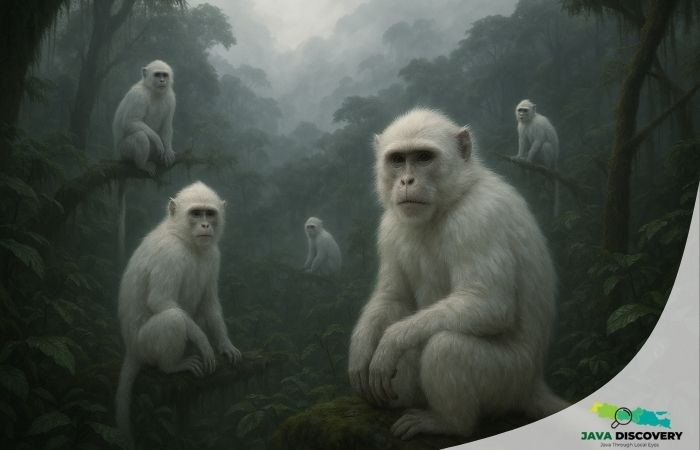
javadiscovery.com – By dawn, Mount Salak often disappears. The mountain folds itself into a white shroud, trees becoming silhouettes and birdcalls dampened by mist. In that moment of hush—when the jungle holds its breath—some hikers swear they have seen them: pale figures among the branches, soundless, watchful, gone as quickly as a blink. Locals call them monyet gaib—ghost monkeys.
A Mountain of Mist and Omen
Mount Salak is not the highest volcano in West Java, but it is one of the most myth-laden. Its ridges are veined with ravines, its weather turns in seconds, and its slopes are famous for fog that erases distance and direction. Elders speak with a careful tone about certain gullies and saddles, places one should pass with humility and focus. Among Sundanese communities, the mountain’s forest is not just habitat—it is leuweung, a living realm that demands respect.
Stories of uncanny encounters are part of Salak’s cultural map. Some tell of lantern lights drifting between trees with no trail to follow. Others warn of paths that loop back to the same mossy boulder, as if the mountain has turned the map inside out. In these tales, the “ghost monkeys” are both sign and guardian: appear when someone is careless, vanish when a pilgrim bows to the forest’s unseen etiquette.

First Sightings and Whispered Reports
Villagers on the forest edge recount quiet glimpses at tree line: a white or pale-grey shape crossing a branch without rustle, a long tail tracing a curve in the fog, a face outlined like chalk. Hikers tell of being watched from a canopy that seems empty. Occasionally, a ranger notes a strange print at the base of a fig tree—no proof, only suggestion.
In old notebooks left by coffee planters and colonial surveyors, there are passages describing “light-coated langurs” and “unusual pallor” seen at dusk near river cuts. Whether memory misled the pen or the forest played tricks with color, the pattern is striking: Salak’s pale primates slip through time like breath on glass—seen, then gone.
Science in the Shadows
Biologists are cautious with ghosts. Salak’s canopy hosts known species—macaques that bark like quarrelsome men, and leaf monkeys whose coats shift from dark soot to silver. In rare cases across the animal world, partial albinism or leucism can wash a body pale. A wet coat in fog can also reflect light, turning a dark primate spectral. And then there is distance: a watcher at the trail, an animal thirty meters away, a veil of mist—the jungle loves to edit.
Yet caution is not disbelief. The Halimun–Salak landscape forms one of Java’s broadest surviving montane forests, a maze of ridges, waterfalls, and strangler figs. Low visibility, steep terrain, and strict protection zones make systematic surveys difficult. Much of what moves in this forest remains undocumented by camera trap or notebook, not because it does not exist, but because Salak is very good at hiding its pages.
Between Worlds: The Spiritual Reading
Ask a kuncen—a mountain custodian—and you may hear this: not everything that wears a body is only body. In their telling, the ghost monkeys are the forest’s messengers, appearing when boundaries thin—at dawn, in rain, near sacred trees or old landslides where the earth still remembers. They watch the living the way the living watch the weather.
For pilgrims who fast or meditate in certain groves, the encounters are not frightening but instructive. A white tail in fog can be a reminder: lower your voice, put away the blade, step around the first sprout of a fern. The lesson is less about proof than posture—how to walk in another’s house without slamming the door.
Field Notes for the Respectful Wanderer
Those who enter Salak’s forest learn quickly that attention is a form of reverence. Soft steps, a slower breath, hands kept off young lianas. When you pause, the forest resumes: cicadas stitch the air, a drongo drops a mimic’s note, and somewhere a fig falls like a muffled drum. Whether you meet the ghost monkeys or not, you feel observed—by moss, by fog, by time.
If you plan to explore the Halimun–Salak area, study the land and its rhythms first. The trails, microclimates, and safety etiquette are as essential as curiosity. For an introduction to the region’s nature and routes, see this resource: Salak Halimun Mountain.
Echoes Through the Mist
In the end, Salak’s ghost monkeys may be a rare primate caught in peculiar light—or something the language of science has not yet phrased. They might also be a parable the mountain tells about humility. In Java’s forests, the visible and the invisible share the same branch. What we call “ghost” may simply be what we have not yet learned to see.
Mist lifts. The canopy brightens. Leaves return to their ordinary green. But some part of you keeps looking into the white, waiting for the branch to move again.