Calligraphy in Javanese Islamic Art and Sacred Expression

javadiscovery.com – In the quiet interior of an old mosque in Demak, light filters through wooden lattice windows and settles gently upon carved pillars darkened by centuries of touch. Along the upper wall, lines of Arabic script curve and extend in deliberate rhythm, each stroke balanced between devotion and design. The letters do not merely convey meaning. They inhabit space. They breathe within carved teak and painted plaster. In Java, Islamic calligraphy is not an isolated ornament. It is a living dialogue between faith, local aesthetics, and the island’s layered history.
Arrival of Script and Transformation of Form
Islam reached Java gradually between the thirteenth and sixteenth centuries through trade networks linking the archipelago to the wider Indian Ocean world. Merchants, scholars, and mystics carried not only belief but also the written word. Arabic script, with its flowing geometry, arrived in port cities such as Gresik and Cirebon, where coastal communities first encountered Islamic teachings.
Yet Java did not simply replicate Middle Eastern artistic conventions. The island already possessed a refined visual culture rooted in Hindu Buddhist temple reliefs, court manuscripts, and intricate batik motifs. When Arabic calligraphy entered this environment, it adapted. The result was not imitation but synthesis.

The Mosque as Canvas
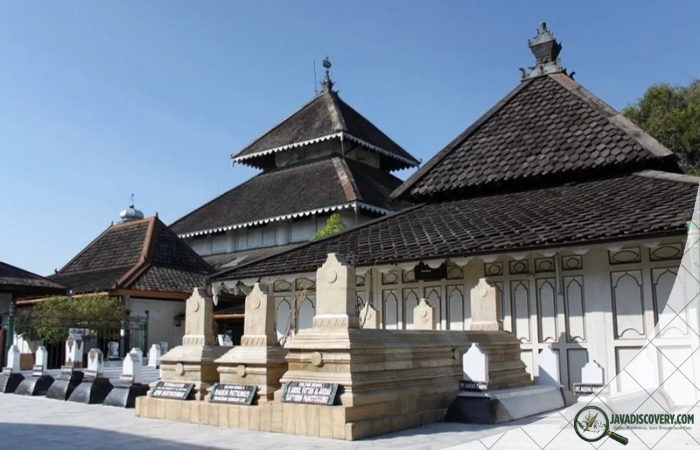
In early Javanese mosques, architectural form differed markedly from domed structures in the Middle East. The Great Mosque of Demak, traditionally associated with the Wali Songo, features a tiered roof reminiscent of pre Islamic sacred buildings. Within such spaces, calligraphy became a subtle yet powerful presence.
Instead of covering entire walls, inscriptions often appeared along beams, mihrabs, or entrance frames. Verses from the Quran were carved into teak panels, the letters elongated to harmonize with wooden grain. The script’s curves echoed the organic motifs already familiar in Javanese carving traditions.
The visual impact is intimate rather than monumental. One must look carefully. The sacred text reveals itself gradually, encouraging contemplation.
Integration with Wayang and Local Motifs
Perhaps the most striking feature of Javanese Islamic calligraphy is its dialogue with local imagery. In some manuscripts and decorative panels, Arabic letters are shaped into silhouettes resembling wayang figures. The elongated limbs of shadow puppets find parallel in the vertical sweep of alif and lam.
This fusion reflects a broader pattern in Javanese Islam, where cultural continuity softened doctrinal transition. Rather than erasing pre Islamic aesthetics, artisans reinterpreted them through Islamic symbolism.
In regions around Surakarta and Yogyakarta, court artists incorporated calligraphic panels into palace complexes. Gold leaf traced sacred phrases against indigo backgrounds. Floral motifs intertwined with script, creating layered compositions that balanced text and ornament.
Gravestones and Memory
Beyond mosques and palaces, calligraphy appears in cemeteries across Java. In the historic burial grounds of Gresik, tombstones of early Islamic scholars bear inscriptions carved in austere elegance. The stone surfaces, weathered by monsoon rains, preserve names, dates, and Quranic verses.
These grave markers represent some of the earliest surviving examples of Islamic calligraphy on the island. Their style often reflects Gujarati and Persian influence, evidence of transoceanic exchange. Yet over time, local stone carvers developed distinctive flourishes, integrating vegetal patterns reminiscent of temple reliefs.
In this context, calligraphy becomes both devotional text and historical record. It anchors memory in material form.
Manuscripts and Pesantren Traditions
Within pesantren, Islamic boarding schools scattered across Java, calligraphy occupies a pedagogical role. Students practice writing Quranic verses by hand, learning not only pronunciation but also the discipline of measured strokes. Ink flows across lined paper in deliberate arcs. The act of writing becomes a spiritual exercise.
In rural pesantren near Jombang, elders describe the patience required to master proper proportion. Each letter must balance thickness and space. A hurried hand disrupts harmony. Through repetition, students internalize rhythm.
Handwritten manuscripts once circulated widely before printed texts became common. Margins often contained decorative flourishes unique to each scribe. These embellishments reveal personality within reverence.
Calligraphy in Batik and Contemporary Art
Java’s renowned batik tradition has also embraced Arabic script. In coastal regions such as Pekalongan, artisans experimented with incorporating Quranic phrases into textile patterns. Letters were stylized, interwoven with floral motifs, forming repeating designs across fabric.
This adaptation sparked debate among religious scholars regarding appropriate contexts for sacred text. Some argued that script should remain within controlled environments such as mosques. Others saw artistic expression as an extension of devotion.
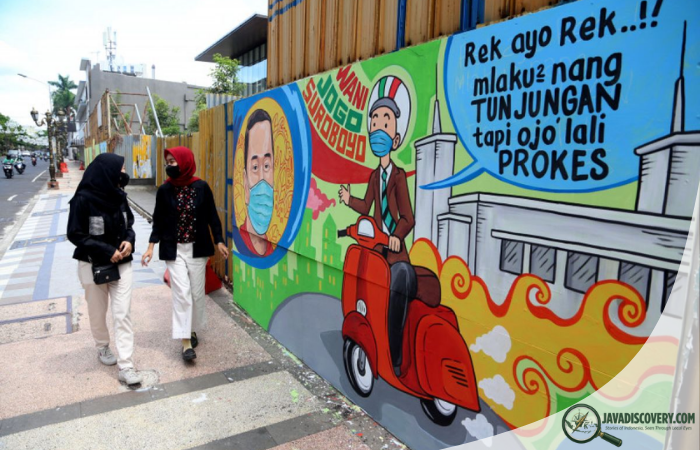
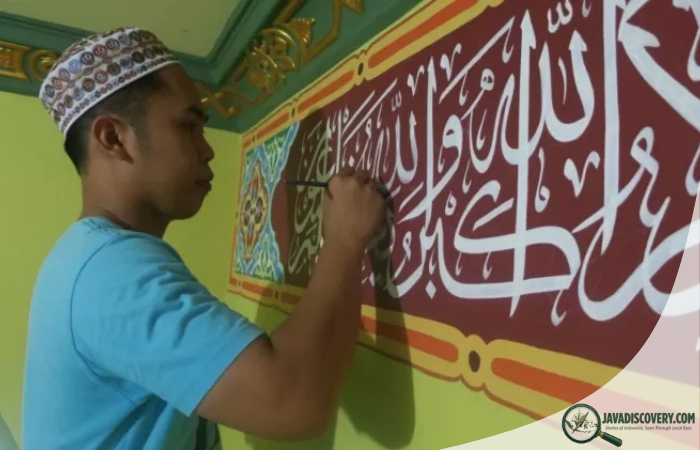
In recent decades, contemporary Javanese artists have revisited calligraphy through modern mediums. Canvas paintings blend bold brushwork with traditional script. Murals in urban neighborhoods feature stylized Arabic phrases layered over abstract backgrounds. The tension between preservation and innovation continues.
Geometry and Spiritual Philosophy
Islamic calligraphy embodies more than aesthetic beauty. Its geometry reflects theological principles. The repetition of curved lines suggests infinity. Balanced symmetry conveys unity. In Javanese interpretation, these qualities resonate with older cosmological concepts emphasizing harmony between human, nature, and the divine.
Standing before a calligraphic panel in a mosque in Yogyakarta, one senses this quiet alignment. The script seems to flow without beginning or end, guiding the eye in continuous motion. Silence surrounds it, yet the visual rhythm feels almost audible.
Preservation Amid Modern Change
Urban expansion and renovation projects sometimes threaten older mosques and cemeteries. Efforts to document and preserve historic calligraphic works have gained urgency. Cultural heritage organizations collaborate with local communities to restore fading inscriptions.
At the same time, new mosques incorporate digital design tools, producing laser cut panels with precise symmetry. The tactile irregularities of hand carving give way to mechanical perfection. Yet even within this modernization, the essence of calligraphy persists as sacred script.
The Quiet Authority of the Written Word
In Java, where oral tradition remains strong, the written Arabic word carries distinct authority. It bridges local belief with global Islamic identity. A villager who cannot read Arabic may still recognize the sacred aura of its form. The script itself becomes a visual marker of faith.
As afternoon light fades in a centuries old mosque, shadows stretch across carved beams. The calligraphy above the mihrab darkens into silhouette. Worshippers depart softly, sandals brushing stone. The script remains, patient and unmoving.
Through centuries of adaptation, Javanese Islamic calligraphy has absorbed local texture without losing sacred origin. It stands as testimony to a cultural encounter that produced neither erasure nor rigid imitation, but creative transformation.
Letters shaped in teak and stone continue to guide the eye upward, reminding viewers that art in Java has long served as a pathway between earth and transcendence.