The Flow of Life: Water Containers and Their Symbolism


javadiscovery.com – In the cool, shadowed corner of a traditional Javanese kitchen, the story of water containers and their symbolism begins with the gentle sweating of a red clay jar. This is the “genthong,” a vessel that does more than merely hold liquid; it breathes, cooling the water through the ancient magic of evaporation and grounding the household’s energy. For the Javanese, water is the “tirta,” the primordial element of purity, and the vessels created to hold it are laden with profound spiritual meaning. Water containers and their symbolism are central to the concept of “manunggal,” the unification of the physical and the divine. From the elegant, breast-shaped “kendi” representing the nurturing mother to the massive stone “padasan” used for ritual ablution, these objects are the silent guardians of “kesucian” or sanctity. In a land defined by volcanic peaks and monsoon rains, the way a person stores and pours water is a direct reflection of their “ngerti” or deep understanding of the cosmic balance that sustains all life.
The Kendi: The Nurturing Mother and Purity
To understand the local reliance on water containers and their symbolism, one must first look at the “kendi.” This unglazed terracotta pitcher, characterized by its rounded belly and elongated neck, is perhaps the most spiritually significant vessel in the Javanese home. The shape of the kendi is widely interpreted as a symbol of the female form, specifically the breast, representing “ibu pertiwi” or Mother Earth. The water contained within is seen as the “air susu” (breast milk) of the universe, providing life, growth, and cooling relief to those who drink from it. Water containers and their symbolism in the form of the kendi are tied to the virtue of selfless giving; the kendi gives its coolness freely, just as a mother provides for her child.
The ritual use of the kendi is a cornerstone of Javanese life transitions. During a wedding, a kendi is often shattered by the elders to signify that the bride is no longer a girl but a woman ready to flow into a new life. In funeral rites, a kendi filled with “air bunga” (flower water) is poured over the grave to cool the spirit of the deceased. These acts demonstrate that water containers and their symbolism are not static; they are active participants in the “upacara” or ceremonies that bridge the visible and invisible worlds. The kendi is a vessel of “suci” (purity), and to offer a guest water from a kendi is the highest sign of Javanese hospitality and “unggah-ungguh” (etiquette).

Local voices in the pottery centers of Kasongan often speak of the kendi as a living being. A master potter, his hands coated in the fine silt of the Progo River, explains that a kendi “must have a soul” to keep the water sweet. This soul is infused during the firing process, where the earth and fire meet to create a skin that can breathe. Water containers and their symbolism are thus an extension of the potter’s own “batin” or inner spirit. When a Javanese person drinks from a kendi, they do not touch their lips to the spout; they let the water stream into their mouth from above, a practice known as “ngombe” that maintains the purity of the vessel for the next person.
The Genthong: The Heart of Domestic Stability
While the kendi is the vessel of ritual and personal thirst, the “genthong” is the architectural anchor of the Javanese kitchen. These large, wide-bellied clay jars are the primary traditional storage systems for the household’s water supply. The role of water containers and their symbolism in the form of the genthong is one of “kemakmuran” or abundance. A full genthong is a sign of a “tentrem” (tranquil) and well-ordered home. It is often placed in the darkest, coolest part of the “pawon” (kitchen), sometimes partially buried in the dirt floor to take advantage of the earth’s constant temperature.
The genthong represents the “rahim” (womb) of the house. It is the source from which all nourishment flows, whether it is the water for the morning rice or the liquid used for herbal “jamu.” Because the clay is porous, the genthong acts as a natural filter and cooler. Water containers and their symbolism here are tied to the Javanese value of “sabar” (patience). The water must sit and settle in the genthong, allowing the sediments to sink to the bottom, just as a person must allow their thoughts to settle to reach clarity. The act of dipping a “gayung” (coconut shell ladle) into the cool depths of a genthong is a sensory ritual that connects the resident to the cooling “roso” (feeling) of the earth.
In many villages, a genthong is placed in front of the house by the roadside, accompanied by a ladle for thirsty travelers. This practice, known as “amal,” elevates water containers and their symbolism from domestic tools to instruments of social merit. It reflects the Javanese belief that water belongs to everyone and that providing it is a duty to the “Gusti” (Divine). The genthong at the gate is a silent ambassador of the family’s character, showing that their home is a place of “berkah” (blessing) where the “tirta” is shared with all who pass by.
The Padasan: The Threshold of Sanctity
The “padasan” is a specialized water container used specifically for “wudhu” or ritual purification before prayer. Traditionally carved from solid volcanic stone or made from heavy terracotta, the padasan is usually located outside, near the entrance of a house or a village “mushola.” Water containers and their symbolism in the form of the padasan are focused on the boundary between the “profane” outside world and the “sacred” interior space. Before one can enter the presence of the Divine, the dust of the world must be washed away using the “air mengalir” (flowing water) from the padasan’s spout.
The design of the padasan often features a small hole at the bottom, plugged with a wooden stopper or fitted with a bamboo pipe. This ensures that the water is always moving, which in Javanese mysticism is a requirement for spiritual cleansing. Stagnant water can harbor “jin” or negative energies, but flowing water is “urip” (alive). Water containers and their symbolism in this context are tied to the concept of “ruwat”—the process of exorcising or cleaning the soul of impurities. The padasan is the physical station for this daily “ruwatan,” a reminder that the body and the spirit must be “resik” (clean) to achieve “manunggal.”
Interestingly, many ancient stone padasans feature carvings of lotuses or mountain motifs, blending Islamic requirements with older Hindu-Buddhist aesthetic traditions. This hybridity is a hallmark of Javanese water containers and their symbolism, showing how the island’s residents have always integrated new beliefs into their fundamental relationship with the elements. The stone padasan is a permanent, unwavering witness to the village’s devotion, its cool surface worn smooth by the touch of thousands of hands seeking a moment of purity before they turn toward the kiblat.
The Gayung and Siwur: Instruments of the Pour
Water containers and their symbolism are incomplete without the tools used to retrieve the water. The “gayung” or “siwur” is the traditional ladle, often made from a polished coconut shell (bathok) with a long bamboo handle. While it is a humble tool, the siwur carries its own weight in Javanese lore. It is the bridge between the human hand and the “tirta” inside the genthong. The use of natural materials like coconut and bamboo ensures that the “roso” of the water is not tainted by metal or plastic, maintaining the “asli” (authentic) quality of the element.
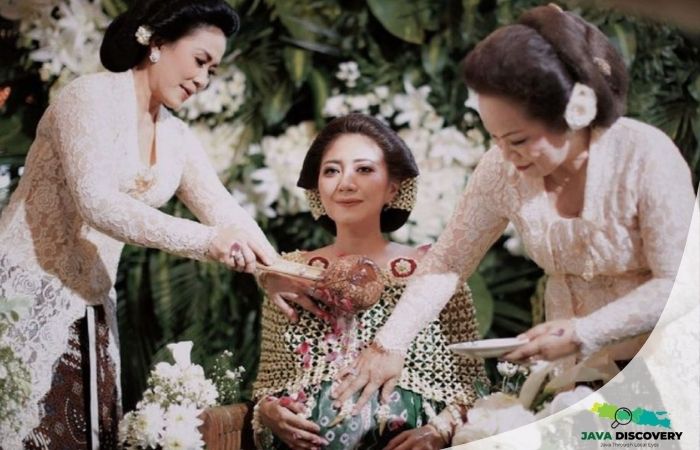
In the “siraman” ritual, a ceremonial bath for a bride-to-be, the siwur is used by seven elders to pour water over the young woman. Here, water containers and their symbolism are focused on the “flow of wisdom.” As each elder pours a ladle of water, they offer a “doa” (prayer). The siwur is the vessel of these blessings. The way the water is poured—slowly and steadily—is a reflection of the “alus” (refined) character that the bride is expected to uphold. A “siwur” that is used only for ritual purposes is often kept as an heirloom, believed to have absorbed the “energi positif” of the prayers it has facilitated over the years.
Even in the daily act of bathing in a “bak mandi,” the movement of the gayung is a rhythmic, meditative process. The sound of the water hitting the body is a reminder of the “hujan” (rain) that feeds the island. Water containers and their symbolism in these mundane moments reinforce the Javanese connection to the “siklus alam” (nature’s cycle). The gayung is a tool of “syukur” (gratitude), allowing the individual to participate in the abundance of the island’s water wealth with every splash.
Symbolic Materials: Clay, Stone, and Wood
The materials chosen for water containers and their symbolism are never accidental. Clay is the primary material because it is “tanah liat”—the living earth. It represents the physical body and the mortality of man. Stone is used for permanent ritual vessels like the padasan because it represents “langgeng” (eternity) and the mountain, the abode of the gods. Wood and bamboo are used for handles and ladles because they represent the “tumbuh” (growth) and flexibility required to navigate life. This elemental trinity ensures that every interaction with water is a holistic experience.
In recent years, the role of water containers and their symbolism has expanded to include a message of environmental conservation. As Java’s rivers face pollution and groundwater levels drop, the traditional “kendi” and “genthong” are being held up as symbols of a more sustainable past. These vessels do not require electricity to cool water, and they are made from biodegradable materials that return to the earth without a trace. The return to the “kendi” in modern Javanese cafes and boutique hotels is not just a stylistic choice; it is a “kesadaran” (awareness) of the need to respect the “tirta” once again.
The “air” (water) inside a clay pot is often described as having “nyawa” (a soul). This is not just a poetic flourish; it is a scientific observation of the way clay mineralizes and oxygenates the liquid. Water containers and their symbolism are thus rooted in a deep, intuitive understanding of health and vitality. To drink from a plastic bottle is seen by many elders as drinking “dead” water, whereas water from a genthong is “air urip”—living water that has been nurtured by the earth. This distinction is at the heart of the Javanese pursuit of “sehat wal afiat” (total well-being).
Conclusion: The Vessel and the Void
Water containers and their symbolism in Java are the physical expressions of a culture that sees the sacred in the mundane. A kendi is never just a bottle; it is a mother. A genthong is never just a jar; it is a womb of stability. A padasan is never just a tap; it is a gate to the divine. These vessels teach the Javanese people how to hold, how to pour, and how to let go. They are the teachers of “nrimo” (acceptance) and “loma” (generosity), reminding every household that life is a flow that must be respected and shared.
As the sun sets and the village grows quiet, the sweat on the outside of the genthong reflects the last light of day. The family gathers to drink, the cool water from the kendi passing from hand to hand. In this simple act, the ancient wisdom of water containers and their symbolism is renewed. The vessel remains, but the water flows through, a reminder that we are all temporary containers for the great, eternal spirit of the “tirta.” As long as the clay is dug and the wheels turn in Kasongan, the story of Java’s sacred vessels will continue to flow, keeping the soul of the island cool, pure, and profoundly grounded.