The Woven Universe: The Cultural Meaning of Baskets and Weaving

javadiscovery.com – In the dappled sunlight of a village veranda in Tasikmalaya, the cultural meaning of baskets and weaving in Java reveals itself through the rhythmic, nimble dance of weathered fingers. Here, a woman sits surrounded by long, supple strips of “bambu” and “pandan” leaves, her hands moving with a fluid intelligence that seems to bypass the conscious mind. To the casual observer, she is merely making a “bakul” or a rice basket, but to the Javanese, she is interlacing the physical world with the spiritual. The cultural meaning of baskets and weaving is rooted in the concept of “anyaman”—the act of crossing and interlocking disparate strands to create a unified, resilient whole. This craft is a living metaphor for Javanese society itself, where individual lives are woven together through “gotong royong” (mutual cooperation) to form a social fabric that is both flexible and incredibly strong. From the sacred “tampah” used in harvest rituals to the humble “besek” that carries village offerings, these woven objects are the silent holders of the island’s identity and communal wisdom.
The Philosophy of Anyaman: Strength in Interdependence
To truly grasp the cultural meaning of baskets and weaving, one must look at the geometry of the weave. In Javanese philosophy, a single strand of bamboo is fragile, easily snapped by the wind. However, once it is woven into a “gedheg” (wall mat) or a “kranjang” (basket), it gains a structural integrity that can support immense weight. This is the essence of “rukun”—the Javanese ideal of social harmony. The weave represents the interdependence of the community; if one strand is pulled too tight or left too loose, the entire basket loses its shape. Thus, the act of weaving is a daily lesson in balance, patience, and the recognition that the strength of the collective far exceeds the sum of its parts.
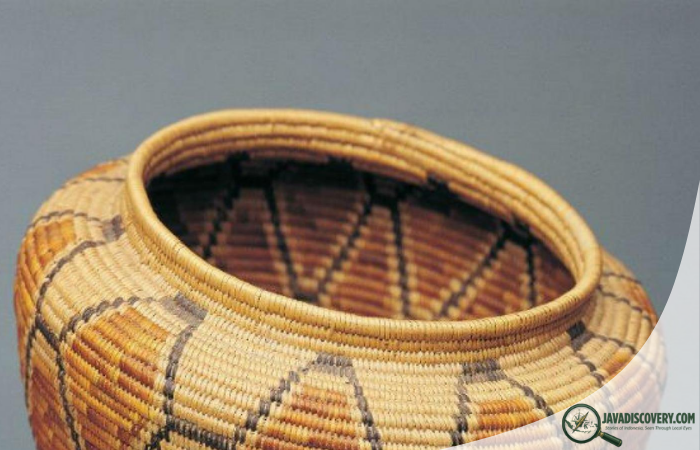
The materials used in the weaving process are equally significant. Java is an island of “bambu” (bamboo), “rotan” (rattan), and “mendong” (a type of marsh grass). Each material carries its own “watak” or character. Bamboo is seen as the resilient warrior—tough, upright, and fast-growing. Pandan is the refined aesthetician—fragrant, soft, and supple. By choosing a specific material, the weaver is imbuing the basket with these natural virtues. The cultural meaning of baskets and weaving is thus a form of “manunggal”—the unification of human intent with the raw energy of the Javanese landscape. A basket is not “manufactured”; it is “grown” through the hands of the artisan.

Local voices in the weaving centers of West and Central Java often speak of the “napas” or breath of the weave. An elderly weaver, her eyes sharp despite her years, explains that a basket must be able to breathe. If the weave is too tight, the contents—whether they be rice, fruit, or flowers—will “sumpek” (stifle) and rot. This breathability is a functional necessity in the humid tropical climate of Java, but it also reflects a spiritual truth: that life requires space and air to flourish. The cultural meaning of baskets and weaving is a reminder that even our most functional objects must remain open to the elements and the flow of the universe.
The Tampah: The Sacred Circle of the Harvest
Perhaps no woven object carries more weight in the cultural meaning of baskets and weaving than the “tampah.” This flat, circular tray is the stage upon which the drama of Javanese life unfolds. Historically, the tampah was used primarily for winnowing rice, the rhythmic tossing and catching that separates the grain from the chaff. This movement is a ritual of discernment, a physical prayer of gratitude to “Dewi Sri,” the Rice Goddess. The circular shape of the tampah represents the “cakra manggilingan”—the Javanese concept of the cyclical nature of time and the eternal return of life and death.
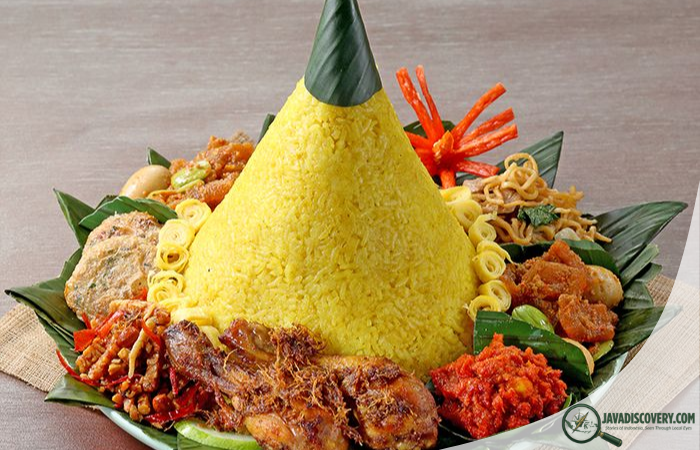
In contemporary Java, the tampah remains the essential vessel for the “tumpeng” (ceremonial rice cone). When the yellow rice is placed in the center of the woven tray and surrounded by side dishes, the tampah becomes a microcosm of the universe. The center represents the sacred mountain, and the woven rim represents the boundary of the known world. To eat from a tampah is to participate in a communal blessing, where the social hierarchy is momentarily dissolved in the shared circle of the meal. The cultural meaning of baskets and weaving is solidified in this moment, as the tray holds the sustenance that feeds both the body and the community’s bond.
The sensory experience of the tampah is deeply nostalgic for many Javanese. The smell of the toasted bamboo, the rough texture of the weave against the fingertips, and the soft “shhh-shhh” sound of the rice being tossed are the sensory anchors of a Javanese childhood. Even in urban apartments, a tampah is often kept as a decorative piece or a functional tray, serving as a “pengeling” (reminder) of the village roots and the grounded nature of Javanese life. It is a piece of the forest brought into the home, keeping the connection to the earth alive.
The Besek: A Vessel of Humility and Offering
The “besek” is a small, square lidded box made from thinly sliced bamboo. Its role in the cultural meaning of baskets and weaving is tied to the concept of “sedekah” or giving. For centuries, the besek has been the primary container for “nasi berkat”—the blessed food given to guests at the end of a “Slametan” or communal prayer. Unlike a plastic container, the besek is humble, biodegradable, and breathes. It conveys a sense of sincerity and “ikhlas” (pure intent). When a guest carries a besek home, they are carrying more than food; they are carrying the shared prayers and the goodwill of the host.
The cultural meaning of baskets and weaving in the form of the besek has seen a powerful resurgence in recent years as a symbol of environmental stewardship. In a modern world drowning in plastic, the return to the besek is a return to Javanese “kebijaksanaan” (wisdom). It represents a rejection of the disposable culture in favor of a sustainable, organic alternative. During the Islamic holiday of Eid al-Adha, many Javanese communities have returned to using besek lined with banana leaves to distribute sacrificial meat, a practice that honors both religious tradition and the Javanese respect for “Ibu Pertiwi” (Mother Earth).
The craftsmanship of a besek is deceptive. While it looks simple, the “anyaman tunggal” (single weave) must be precise to ensure the lid fits perfectly over the base. This precision is a form of “ketelitian” or meticulousness. A well-made besek is a testament to the weaver’s character. In the past, a young woman’s skill in weaving a besek was often seen as a measure of her readiness for marriage and her ability to manage a household with grace and order. The cultural meaning of baskets and weaving is thus intimately tied to the development of the self and the mastery of the domestic arts.
The Kranjang and the Market: The Weave of Commerce
In the bustling “pasar” (traditional markets) of Java, the cultural meaning of baskets and weaving is on full display in its most rugged and utilitarian forms. The “kranjang”—large, heavy-duty baskets made from thick bamboo splits—are the engines of Javanese commerce. They carry everything from mountain-grown cabbages and volcanic soil to live poultry and hand-dyed textiles. These baskets are designed to be stacked, tied to the backs of motorbikes, and dragged across cobblestones. They are the rugged foot soldiers of the weaving world.
The kranjang represents the “tenaga” or the raw energy of the Javanese people. There is a specific beauty in a well-used market basket, its bamboo polished to a dark amber by years of sweat, rain, and friction. The story of the kranjang is the story of the “bakul”—the traditional market women who carry these heavy loads on their backs using a “selendang” (cloth sling). The basket and the woman become one unit of labor, a testament to the resilience and strength that define Javanese womanhood. The cultural meaning of baskets and weaving here is one of endurance and the dignity of manual work.
In these markets, you can also see the “tenggok” and the “bronjong.” The tenggok is a deep, sturdy basket often used for carrying harvested paddy or heavy loads of tubers. The bronjong is a pair of oversized baskets slung over the back of a bicycle or motorcycle. The engineering of these baskets is a local response to the island’s topography. In the steep volcanic slopes where trucks cannot go, the woven basket remains the most efficient technology for moving goods. The cultural meaning of baskets and weaving is therefore inseparable from the Javanese ability to adapt and thrive in a challenging landscape using only the materials provided by the earth.
The Spiritual Weave: Katu and Protective Charms
Beyond the functional, the cultural meaning of baskets and weaving extends into the realm of the “gaib” or the supernatural. In certain parts of Java, specific weaving patterns are believed to have protective qualities. A “katu”—a small, woven talisman made from young coconut leaves (janur)—is often hung above the doorway of a new house or near a newborn’s cradle. The intricate, interlocking knots of the katu are intended to “entrap” negative spirits, preventing them from entering the domestic sanctuary.
This protective aspect of weaving is also seen in the “ancak,” a temporary bamboo frame used to hold elaborate “sesaji” (offerings) during major rituals like the “Bersih Desa” (village cleansing). The ancak is not meant to last; it is woven quickly and then returned to the earth after the ritual is complete. This impermanence is a key part of the cultural meaning of baskets and weaving. It reflects the Javanese understanding of “eling” (mindfulness)—the awareness that all physical forms are temporary vessels for spiritual energy. The act of weaving the ancak is more important than the object itself, as the weaver’s focus and prayers are woven into the structure.
The use of “janur” (young yellow coconut leaves) in weaving is particularly sacred. Janur weaving is a central part of Javanese weddings, where “kembar mayang” (twin decorative arrangements) are created to symbolize the union of two souls. The “anyaman janur” represents the blossoming of new life and the hope for a fruitful future. The cultural meaning of baskets and weaving in this context is a celebration of “keindahan” (beauty) and the divine grace that permeates every aspect of human transition. The weaver of janur is a poet of the palm leaf, using fleeting materials to express eternal truths.
Modernity and the Resilience of the Fiber
As Java urbanizes and mass-produced plastic goods become ubiquitous, the cultural meaning of baskets and weaving is undergoing a transformation. What was once a daily necessity is increasingly becoming a valued “kerajinan” (handicraft) or a high-end design element. Contemporary Javanese designers are collaborating with village weavers to create modern furniture, lighting, and fashion accessories that use traditional “anyaman” techniques. This evolution is ensuring that the ancient skills remain economically viable in a globalized world.
However, the true resilience of the craft lies in its spiritual and social roots. As long as the Javanese people continue to hold “Slametan,” as long as they value “gotong royong,” and as long as they seek a connection to “Ibu Pertiwi,” the woven basket will have a place in their lives. The cultural meaning of baskets and weaving is not a relic of the past; it is a living philosophy that continues to offer a sustainable and harmonious way of being. In a world of cold, hard lines and sterile materials, the warmth and flexibility of a woven bamboo basket offer a profound sense of comfort and belonging.
The weaver in Tasikmalaya continues her work as the sun begins to set. Her basket is nearly finished, a perfect vessel of interlocking strength and beauty. She trims the final stray fibers with a small knife, her movements calm and deliberate. She is not just making a tool for the kitchen; she is reinforcing the invisible threads that hold her world together. The cultural meaning of baskets and weaving is found in this quiet persistence—the belief that through the simple act of crossing one strand over another, we can build a universe that is whole, holy, and built to last.