The Tilling of Time: The Evolution of Javanese Farming Tools

javadiscovery.com – In the emerald amphitheaters of the Wonosobo highlands, the evolution of Javanese farming tools begins with the heavy, rhythmic thud of a steel blade striking the dark volcanic earth. This is the “pacul” or the traditional hoe, an implement that has remained the primary extension of the farmer’s arm for centuries. To witness a Javanese farmer turning the soil is to see a living history of the island’s agricultural heart. The evolution of Javanese farming tools is not merely a timeline of industrial progress, but a narrative of “manunggal”—the unification of the human spirit, the seasonal rains, and the fertile silt of the mountains. From the ancient stone scrapers of the Neolithic era to the hand-steered “traktor sawah” that now hums across the plains, these instruments have carved the very identity of Java, shaping the terrace walls that define the landscape and the social structures that sustain the village community.
The Primordial Blade: The Era of the Pacul and Sabit
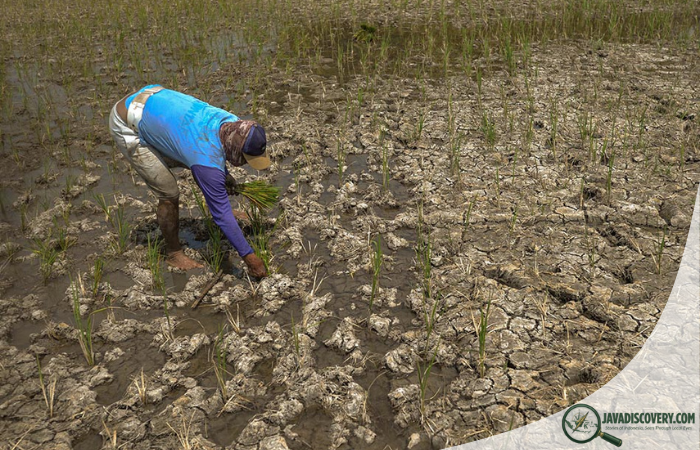
To understand the evolution of Javanese farming tools, one must start with the “pacul.” While it may appear simple, the design of the Javanese hoe is a masterclass in ergonomics and soil science. The blade is angled specifically to bite into the heavy, clay-rich mud of the “sawah” (wet rice field) without sticking. For generations, the pacul has been the tool of the “petani,” used not only for tilling but for sculpting the intricate irrigation dikes that manage the flow of water. In the Javanese worldview, the pacul is a symbol of “kerja keras” or hard work; it is the tool that transforms the wild jungle into a disciplined, life-giving garden.
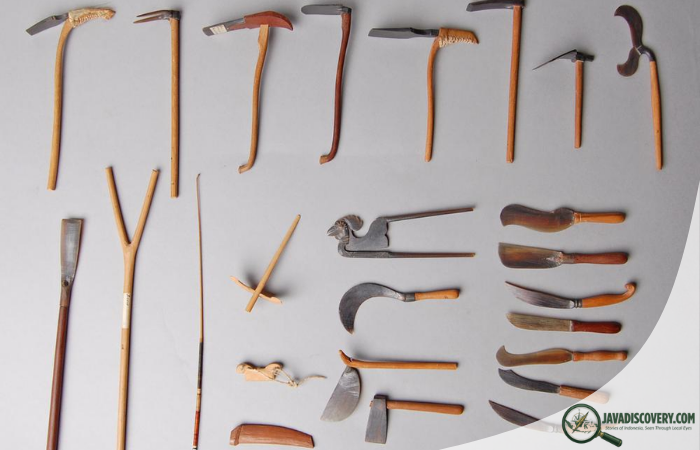
Alongside the pacul is the “sabit,” the curved sickle used for harvesting and clearing brush. The sabit is forged from high-carbon steel, often by village “pandhe besi” (blacksmiths) who understand the specific toughness of Java’s tropical grasses. The evolution of Javanese farming tools of this era was defined by local self-sufficiency. Every tool was repairable, sharpenable, and uniquely weighted to the owner’s height and strength. This intimate connection between the farmer and the tool ensured that the “roso” or the feeling for the land was never lost. A farmer could feel the health of the soil through the vibration of the pacul handle, a sensory feedback that modern machinery has struggled to replicate.

Local voices in the rural regions of Yogyakarta often speak of the “sabit” as a protective companion. An old farmer, his skin as weathered as the teak handle of his tool, explains that a sabit is never just a knife. It is a partner in the “ngarit” (grass cutting) ritual, a daily task that sustains the livestock and keeps the edges of the fields clean. The evolution of Javanese farming tools in the manual era was slow, characterized by subtle refinements in metallurgy and handle shape that were passed down through oral tradition and apprenticeship, ensuring the tools remained as resilient as the people who swung them.
The Power of the Beast: The Garu and the Water Buffalo
A significant leap in the evolution of Javanese farming tools occurred with the domestication of the “kerbau” or water buffalo. The introduction of the “garu” (harrow) and the “luku” (plow) shifted the scale of Javanese agriculture from individual plots to expansive communal fields. The garu is a heavy wooden rake-like structure pulled by a pair of buffalo, used to break up the clods of earth and level the mud after the first plowing. This was the first “machine” in the Javanese kitchen-garden, a synergy of animal power and wooden engineering.
The relationship between the farmer, the buffalo, and the garu is a cornerstone of Javanese “gotong royong” (mutual cooperation). The pace of the buffalo dictated the pace of life—slow, steady, and in harmony with the natural cooling of the day. The evolution of Javanese farming tools during this period focused on the “kayu jati” (teak wood) and “bambu” (bamboo) used to create the yokes and frames. These materials were chosen for their ability to withstand the constant moisture of the sawah without rotting. The garu was not just a tool for the soil; it was a tool for the soul, requiring a deep, quiet communication between the man and the beast as they waded through the knee-deep mud under the tropical sun.
The sound of the garu squelching through the mud and the low grunts of the kerbau are the soundtrack of ancient Java. This era represented a peak of ecological balance, where the waste from the buffalo fertilized the very fields they tilled. The evolution of Javanese farming tools was, at this stage, a closed loop. However, as the population of Java grew and the demand for rice intensified, the limitations of animal power became apparent. The “green revolution” of the mid-20th century would soon bring the next major transformation to the fields, introducing iron and oil to the ancient mud.
The Iron Revolution: The Rise of the Hand Tractor
In the late 20th century, the evolution of Javanese farming tools underwent a rapid and noisy transformation. The “traktor tangan” or hand tractor—often referred to as the “iron buffalo”—began to replace the living kerbau. These two-wheeled diesel machines, steered by a farmer walking behind them, could do the work of several buffalo in a fraction of the time. The transition was a cultural shock to the rural landscape. The quiet “klik-klik” of the wooden plow was replaced by the thrumming roar of the engine, and the scent of damp earth was joined by the smell of diesel exhaust.
Despite the change in power source, the evolution of Javanese farming tools in the mechanical age remained surprisingly traditional in its application. The hand tractor was adapted to fit the small, terraced plots of Java. Heavy treaded iron wheels were fitted to allow the machine to grip the slippery volcanic clay. The farmer still walked in the mud, still felt the resistance of the earth, and still guided the machine with the same “alus” (refined) precision they had used with the buffalo. The “iron buffalo” did not erase the farmer’s skill; it amplified it, allowing for the three-crop-per-year cycles that now feed Indonesia’s millions.
The evolution of Javanese farming tools also saw the introduction of the “thresher” and the “huller,” replacing the manual “lesung” (large wooden mortar) and “alu” (pestle). For centuries, the rhythmic pounding of the lesung by groups of women was the heartbeat of the village. The mechanization of this process moved the work from the communal courtyard to small local mills. While this increased efficiency and reduced physical burden, it also changed the social fabric of the village, shifting the harvest from a musical, collective event to a faster, more commercialized operation.
The Ani-Ani: The Tool of the Rice Goddess
No discussion on the evolution of Javanese farming tools is complete without the “ani-ani.” This is a small, palm-held finger knife used to harvest individual stalks of rice. Unlike the sabit, which cuts a large bunch of stalks at once, the ani-ani is a tool of surgical precision and profound spiritual significance. It is tied to the myth of “Dewi Sri,” the Rice Goddess. According to Javanese belief, the rice spirit is easily frightened; if harvested with a large, aggressive sickle, the goddess might flee, causing the next harvest to fail. The ani-ani, hidden in the palm of the hand, allows the farmer to “whisper” to the rice, harvesting it so gently that the goddess does not notice.
The evolution of Javanese farming tools often involves the replacement of the old by the new, but the ani-ani represents a different path. For centuries, it was the only tool used for harvest, ensuring that only the ripe ears were taken. However, with the introduction of high-yield rice varieties that ripened all at once, the ani-ani began to fade, replaced by the more efficient sabit and, eventually, the combine harvester. Yet, in certain “adat” (traditional) villages, the ani-ani is still used for sacred plots. Its survival is a testament to the Javanese desire to maintain a “spiritual ecology,” where the method of work is as important as the result.
The physical design of the ani-ani—a small wooden block with a tiny blade—is a masterpiece of minimalist engineering. It requires a specific flick of the thumb and forefinger, a motion that becomes second nature to the women who traditionally performed the harvest. The story of the ani-ani in the evolution of Javanese farming tools is a reminder that efficiency is not the only metric of progress. Sometimes, the most “advanced” tool is the one that preserves the respect between the human and the divine.
Modernity and the Precision of the Sawah
In the 21st century, the evolution of Javanese farming tools is entering the era of “smart farming,” though it looks very different in Java than it does in the vast plains of the West. Small-scale drones are now being used in the lowland plains of East Java to spray organic fertilizers and monitor crop health. Solar-powered water pumps are replacing the old diesel ones, providing a cleaner, quieter way to manage the “irigasi.” The evolution of Javanese farming tools is now focusing on sustainability and the reduction of chemical inputs, returning to some of the organic principles of the “buffalo era” but with high-tech assistance.
The modern Javanese farmer is a bridge between two worlds. They may use a smartphone to check weather patterns or market prices, but they still carry a “pacul” to fix a breach in a dike. They may hire a mechanical harvester, but they still leave a “sesaji” (offering) of flowers and incense at the water gate. This hybridity is the current stage in the evolution of Javanese farming tools. The tools are becoming more precise, but the goal remains the same: to produce “beras” (husked rice) that is not just food, but a blessing for the family and the community.
The resilience of the old tools within the new system is remarkable. In the steep volcanic slopes of Dieng or Tengger, where no tractor can go, the “pacul” remains the king of the mountain. Here, the evolution of Javanese farming tools seems to have paused, acknowledging that human muscle and hand-held steel are still the most effective ways to manage the vertical earth. This geographic reality prevents the total “modernization” of Javanese farming, ensuring that the ancient skills are not forgotten.
The Legacy of the Iron and the Earth
As we look at the evolution of Javanese farming tools, we see a cycle of constant adaptation. The Javanese have never been afraid of new technology, but they have always filtered it through the lens of their own values. A tool is only useful if it maintains the “harmoni” of the village. The tractor is accepted because it eases the “beban” (burden) of the farmer, but the ritual of the first planting is kept because it satisfies the “batin” (inner spirit). This pragmatic spirituality is the engine that drives the evolution of Javanese farming tools.
The tools themselves, whether a rusted Neolithic scraper or a gleaming new hand tractor, are the “saksi bisu” (silent witnesses) to the island’s history. They carry the sweat of ancestors and the hopes of the new generation. To hold a pacul today is to touch the same iron and wood that built the great temples of Borobudur and Prambanan, for it was the rice surplus created by these tools that allowed those civilizations to flourish. The evolution of Javanese farming tools is the evolution of Java itself—a story of fire, soil, and a people who have mastered the art of tilling the time.
As the sun sets over the rice fields, casting long, golden shadows across the furrows, the farmers clean their tools in the irrigation channels. The steel of the pacul glints in the twilight, stripped of the day’s mud. Tomorrow, the cycle will begin again. Whether with a buffalo or a machine, the hand of the Javanese farmer will reach out to the earth, guided by the tools that have evolved but never lost their soul. The evolution of Javanese farming tools continues, a testament to the enduring relationship between the people of Java and the land that sustains them.