Inside Joglo The Sacred Philosophy of Javanese Home Design

javadiscovery.com – The transition is subtle yet profound, a crossing of a threshold that separates the chaotic, sun-drenched vibrancy of the Javanese street from the cooling, timber-scented sanctuary within. As one steps onto the stone floor of the pendopo, the roar of motorbikes and the heat of the midday sun fade into a distant memory, replaced by the hushed stillness of a space designed not just for living, but for breathing in harmony with the cosmos. This is the Joglo, the traditional architectural marvel of Java, where every beam, every carved pillar, and every sloping roofline serves as a physical manifestation of ancient philosophy and a deep, intuitive understanding of the relationship between man, nature, and the divine.
A Cosmology Carved in Wood
To view a Joglo merely as a house is to misunderstand its purpose entirely. It is a microcosm, a scaled-down representation of the Javanese worldview where the earth and the heavens are inextricably linked. The structure is built with a specific orientation, usually facing north or south, aligning it with the invisible currents of energy that the Javanese believe flow across the landscape. The roof, which is the most distinctive feature of the building, is not merely a cover for protection. It is a symbol of the mountain, the sacred height where the ancestors reside and where the spiritual power of the universe concentrates.
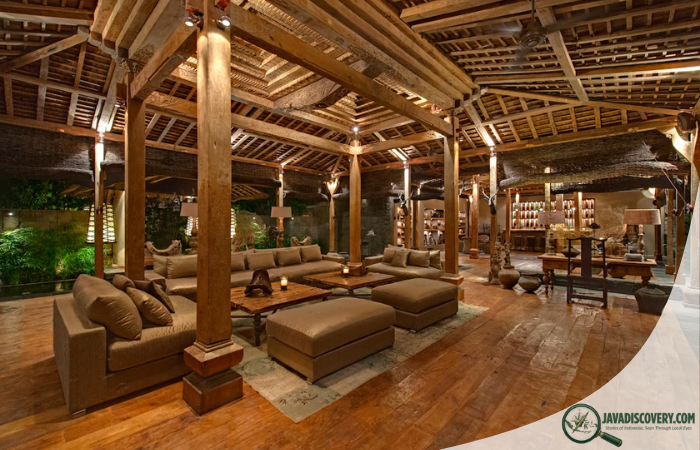
The roof structure, known as the tumpang sari, consists of stacked, tiered wooden layers that ascend toward a central peak. This complex engineering feat requires no nails in its traditional form, relying instead on the precise fit of interlocking joints that allow the building to sway and settle without collapsing during the frequent tremors that characterize the Indonesian archipelago. It is a lesson in flexibility, a structural philosophy that mirrors the Javanese approach to life: to survive the shocks of existence, one must be resilient, able to bend without breaking, and fundamentally connected to the foundation beneath one’s feet.

The Pendopo as a Social Mirror
The foremost part of the Joglo is the pendopo, an open-sided pavilion that functions as the living room of the community. In the days of the old kingdoms, the pendopo was where the nobility would receive their subjects, but in the village context, it remains a space of absolute transparency. There are no walls here. The absence of barriers is a physical manifestation of the Javanese value of openness and equality. It invites the outside in, allowing the breeze to circulate freely and welcoming the presence of others.
When one sits on the polished teak floor of a pendopo, the experience is grounding. The four central pillars, known as the soko guru, rise from the ground to support the weight of the massive roof above. These four pillars represent the four cardinal directions, the four elements, and the four stages of human development. They are the strongest part of the house, the anchor that holds the entire structure in place. In a social sense, they represent the pillars of the community—the elders, the leaders, and the ancestors—whose guidance supports the life of the family. To lean against a soko guru is to physically connect with the strength of generations past.
The Dalem and the Inner Sanctum
If the pendopo is the face of the house, looking outward toward the world, the dalem is its heart, tucked away in the shadows of the rear section. The transition from the pendopo to the dalem is marked by a shift in atmosphere. The light grows dimmer, the air feels cooler and heavier with the scent of aged wood, and the privacy becomes absolute. This is the inner sanctum, the private realm where the family resides, where rituals are performed, and where the most precious heirlooms are kept.
The dalem represents the depth of the Javanese soul. It is a space for introspection, for prayer, and for the quiet cultivation of the inner self. While the pendopo is for the community, the dalem is for the individual and the family unit. The separation between these two spaces reflects the fundamental Javanese concept of balancing the outward social identity with the inward spiritual life. One cannot exist without the other; the public life of a person is sustained by the strength and clarity found in their private life. In the dalem, there is no pretense, no performance for the public, only the raw, unadorned truth of one’s existence.
The Artistry of Teak
The soul of a Joglo is found in its material: jati, or teak. This wood, known for its extraordinary durability, resistance to rot, and deep, honeyed grain, is the canvas upon which Javanese artisans have poured their skill for centuries. In a traditional Joglo, the wood is not painted or covered. It is left to age naturally, darkening over the decades to a rich, burnished mahogany. Every scratch, every knot, and every polished surface tells a story of the years that have passed within those walls.
The carving that adorns the beams and the pillars is not merely decorative. It is a language of symbols. Floral patterns, geometric shapes, and stylized mountain forms are carefully etched into the timber, each carrying a specific meaning related to prosperity, protection, and the cycle of life. The artisans who work on these structures do not view themselves as mere builders. They are practitioners of a sacred craft, requiring a state of focus and spiritual purity before they even lay a chisel to the wood. They believe that the energy of the maker is imbued into the structure, that the house itself will carry the temperament of those who built it.
Pringgitan The Bridge of Shadows
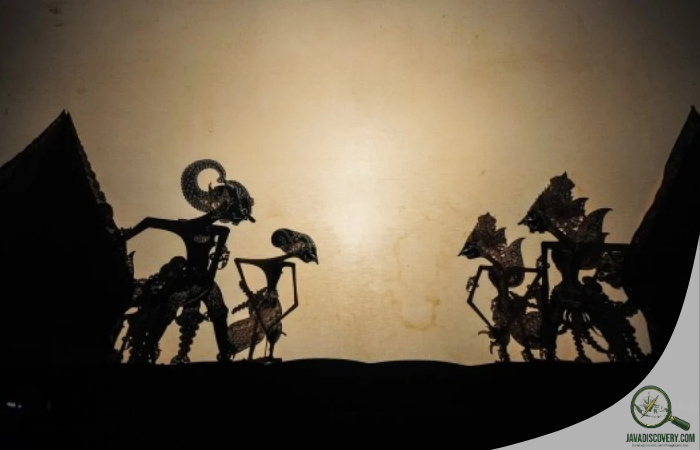
Between the pendopo and the dalem lies the pringgitan, a transitional space that serves as a corridor or a foyer. Historically, this area was used as the stage for wayang kulit, the traditional shadow puppet performances. In the dark of the evening, with a screen set up and a lamp glowing, the pringgitan became a portal between the mundane world and the world of the spirits. The shadows cast by the leather puppets on the screen represented the complexities of human life, the battle between good and evil, and the nuances of moral choice.
This architectural choice is profoundly symbolic. It places the family’s living space in constant dialogue with the myths and legends that shape their identity. The Joglo is not a static object; it is a theatre of life. Every day, the residents move through these spaces, enacting their own dramas, their own small rituals, and their own journeys of discovery. The house is a reminder that life is a performance, that we are all playing our roles in a vast, cosmic narrative, and that our actions are being observed not just by our neighbors, but by the ancestors who watch from the rafters.
The Joglo in the Modern World
As Java urbanizes and the pressures of modern life increase, the Joglo faces an uncertain future. The land required to build a traditional house is becoming a luxury, and the materials, particularly high-quality, aged teak, are becoming increasingly scarce. Many historic Joglos are being dismantled, sold, and transported to be reassembled as luxury villas or boutique hotels. While this preservation effort saves the structures from destruction, it often strips them of their original context, moving them from the village setting where they belonged to artificial environments where they become museum pieces rather than homes.
Yet, there is a growing movement of architects and homeowners who are seeking to integrate the philosophy of the Joglo into contemporary designs. They are not trying to replicate the past, but to capture the essence of what made these houses so effective. They are using the open-plan layouts to encourage social interaction, prioritizing natural ventilation to reduce the need for air conditioning, and using sustainable, locally sourced timber to create spaces that feel grounded and authentic. They are proving that the wisdom contained within the traditional Joglo is not tied to a specific era, but is a timeless approach to creating a home that nurtures the human spirit.
Living with Intention
To live in a Joglo is to submit oneself to a different pace of life. It is to accept the limitations of the house—the way it lets in the rain during a storm, the way it requires constant maintenance to keep the wood from warping, the way it exposes one to the sights and sounds of the surrounding environment. But in exchange, it offers a quality of life that is increasingly rare in the modern age. It offers a sense of proportion, a connection to the cycles of nature, and a constant, tactile reminder of one’s place in the wider web of existence.
The Joglo does not demand that you master your environment. It asks that you cooperate with it. It does not demand that you hide from the world. It asks that you create a space where you can engage with the world on your own terms. It is an architecture of humility, a structure that acknowledges that the most important things in life are not the walls we build around us, but the relationships we foster within that shelter.
As the sun sets over the Javanese countryside, casting the silhouettes of the volcanoes against the orange sky, the Joglo takes on a different character. The wood glows in the dying light, and the shadows lengthen across the pendopo floor. It is a quiet, contemplative time. The house seems to settle into the earth, anchoring itself for the coming night. Inside, life continues as it has for centuries—a meal is shared, a conversation unfolds, and the cycle of the day is brought to a peaceful close. The Joglo remains, a silent guardian of culture, a testament to the Javanese genius for finding beauty in the balance between the light and the dark, the public and the private, the earth and the sky.