South Coast Fishermen Living With the Risks of the Open Ocean

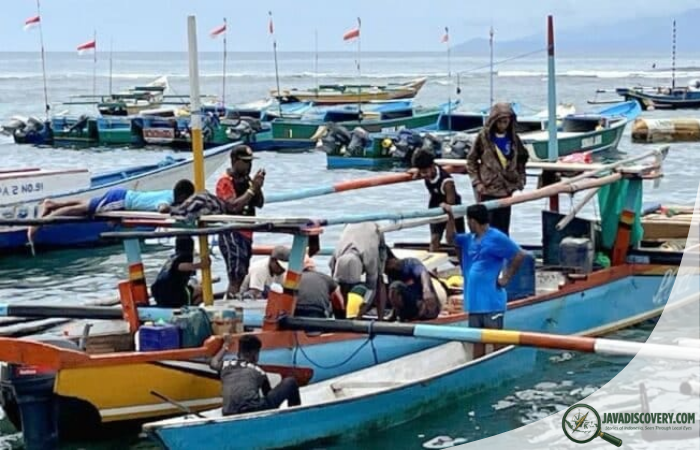
javadiscovery.com – At dawn along Java’s southern coast, the sky turns pale orange above an ocean that rarely sleeps. Waves roll in from the vast Indian Ocean, heavy and relentless, breaking against black volcanic sand and jagged reefs. Wooden fishing boats wait on the beach, their hulls painted in fading blues and greens, their bows decorated with symbols meant to bring protection. Men gather around them in silence, pushing the boats closer to the waterline, watching the rhythm of the surf with careful eyes.
For generations, fishing communities along Java’s southern shoreline have lived with an uneasy partnership with the sea. The ocean here is both provider and threat. It feeds families, defines identity, and shapes entire villages. But it is also unpredictable, powerful, and unforgiving.
Along the southern arc of the island, from the rocky bays of East Java to the sweeping beaches of Central Java and the cliffs of the west, fishermen face conditions very different from the calmer waters of Java’s northern coast. Here, the Indian Ocean dominates the horizon, sending swells that travel thousands of kilometers before crashing onto Java’s shores.

Every departure from the beach is an act of knowledge, skill, and courage.
The Geography of Risk
The southern coast of Java faces one of the most powerful bodies of water on Earth. Unlike the sheltered Java Sea to the north, the Indian Ocean stretches uninterrupted toward Antarctica. Waves arriving at the island’s shoreline often carry immense energy, creating surf that can reach several meters high.
Fishing villages such as those near :contentReference[oaicite:0]{index=0}, :contentReference[oaicite:1]{index=1}, and :contentReference[oaicite:2]{index=2} have developed traditions specifically adapted to this environment.
Boats here are designed differently from those used on calmer seas. Many are narrow wooden vessels with strong outriggers that help stabilize them when navigating rough water. Their engines are modest, but their construction reflects generations of trial and error.
Launching these boats is often the most dangerous moment of the day.
When waves surge toward the beach, fishermen must time their departure carefully. A group pushes the vessel forward, waiting for the precise moment when the retreating water creates a brief corridor of calmer surface. The engine roars to life, and the boat surges through the breaking surf before the next wave collapses behind it.
A mistake of a few seconds can flip the boat or smash it against the shore.
Reading the Ocean
Long before satellite weather forecasts or digital navigation tools, fishermen along the south coast developed deep knowledge of the sea’s subtle signals.
They watch the color of the water. Darker shades often indicate deeper channels where fish gather. Lines of foam reveal currents moving beneath the surface. The flight patterns of seabirds can hint at schools of fish moving below.
The wind carries messages as well. A warm breeze from the west might signal changing weather. Sudden stillness can mean storms building beyond the horizon.
Pak Wardi, a fisherman from a village west of Pangandaran, explains it simply. “The ocean speaks if you learn how to listen,” he says while repairing a net beneath a palm tree. His hands move slowly through the tangled threads, practiced and patient.
“When the waves breathe differently, we know.”
That knowledge does not remove danger, but it offers fishermen a measure of control in an environment that cannot be fully mastered.
Life Built Around the Tide
Daily life in south coast fishing villages revolves around the rhythm of the tide. Boats often depart in the early morning or late afternoon when wind conditions are more manageable.
On shore, families prepare equipment long before the fishermen return. Nets are mended, baskets cleaned, and small food stalls ready themselves for the bustle that follows a successful catch.
Children grow up surrounded by this rhythm. Boys often accompany fathers or uncles to the beach from an early age, learning how to read waves and tie knots. Girls help process the fish, sorting anchovies, tuna, and mackerel into baskets bound for local markets.
Evenings are filled with the scent of grilled seafood drifting through narrow lanes between houses. Conversations revolve around the sea. Which currents carried fish today. Which boats struggled against strong swells.
The ocean shapes not just livelihoods but social life itself.
Storms and Uncertainty
Despite experience and knowledge, storms remain the greatest threat. Sudden weather changes can transform manageable waves into violent seas within minutes.
During monsoon transitions, towering clouds can build rapidly above the horizon. Fishermen caught far from shore face terrifying conditions. Engines strain against rising winds, and waves crash against the hull with thunderous force.
Some boats never return.
Villages carry memories of such losses quietly but deeply. Photographs of missing fishermen hang in family homes. Community prayers mark anniversaries of storms that took fathers, brothers, and sons.
These tragedies reinforce a shared understanding among coastal families: the sea demands respect.
Belief and Protection
In many south coast villages, spiritual beliefs remain closely tied to the ocean.
Fishermen often perform small rituals before launching their boats. Offerings of flowers, rice, or incense may be placed near the waterline. These gestures express gratitude and request protection from unseen forces.
In parts of southern Java, the ocean is associated with the legendary figure :contentReference[oaicite:3]{index=3}. Stories describe her as the powerful guardian of the southern ocean, a presence both feared and respected.
While interpretations vary, many fishermen acknowledge the legend as part of the cultural landscape. It reinforces humility before the vastness of the sea.
Whether through faith, ritual, or simple tradition, these practices help fishermen confront uncertainty that cannot be eliminated.
Changing Oceans
In recent decades, fishermen have begun noticing changes in the ocean itself.
Fish migrations have shifted. Species once abundant near shore now require longer journeys to locate. Some fishermen attribute this to climate change affecting ocean temperatures. Others point to increased fishing pressure from larger commercial vessels operating further offshore.
Plastic pollution has also appeared in nets that once held only fish and seaweed. Floating debris occasionally damages engines or tangles in fishing gear.
These challenges add new layers of uncertainty to an already difficult profession.
Adapting to Survival
To cope with changing conditions, many fishing communities are adapting their methods.
Some fishermen diversify their catch, targeting squid or different fish species depending on seasonal availability. Others combine fishing with tourism related work during calmer months.
In villages near Pangandaran, younger fishermen experiment with GPS technology and modern sonar devices. These tools help locate fish more efficiently, reducing time spent navigating dangerous waters.
Yet older fishermen emphasize that technology alone cannot replace experience.
“Machines show you numbers,” Pak Wardi says. “But the ocean still speaks first.”
The Courage of Departure
Every morning along Java’s south coast begins with the same quiet moment.
Fishermen stand beside their boats, scanning the surf. The waves rise and collapse with steady force. Seabirds circle above the water, and the sky slowly brightens.
Then someone gives the signal.
Men push together, boots digging into wet sand. The boat slides forward, its engine roaring awake as it meets the first wall of water. Spray flies into the air. For a moment, the vessel disappears behind the breaking surf.
Then it emerges on the other side, riding the swell toward open water.
On shore, families watch until the boat becomes a small silhouette against the horizon.
This daily departure captures the reality of south coast fishing life. It is a profession built on endurance, skill, and collective knowledge passed through generations.
The ocean provides food and livelihood, but never certainty.
And yet, each dawn, the fishermen return to the water.
Because along Java’s southern edge, life has always been lived between the promise of the sea and the risks it carries.