Willem’s Toren III Lighthouse, A Beacon at Indonesia’s Edge

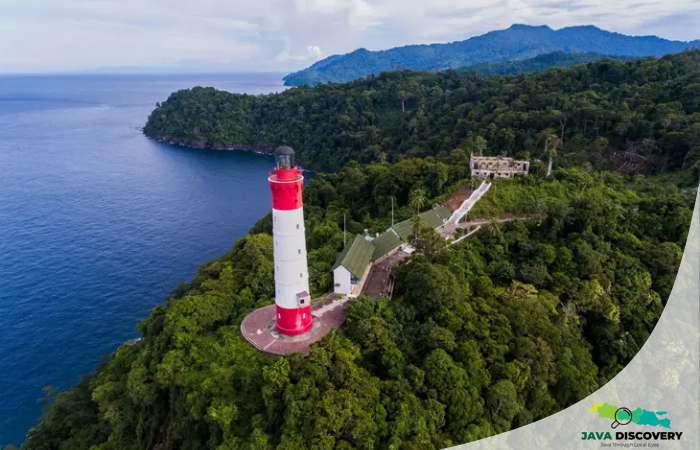
javadiscovery.com – On a granite crown that lifts Pulau Breueh above the restless horizon of the Indian Ocean, Willem’s Toren III stands as a silhouette of iron and mortar against the dawn. From a distance it looks less like a human construction and more like a patient vertebra of the coastline — pale and resolute, bearing the salt-scraped history of ships, storms and colonial maps. The air there tastes of iron and seaweed; gulls wheel with a staccato of wings and the spray keeps time with a low, steady percussion on the rock below.
Perched on the island: place, scale and first impressions
Pulau Breueh — sometimes called Pulau Beras in local accounts — is a green thumbprint of an island off the northwestern tip of Sumatra. The lighthouse occupies a small plateau at roughly 310 meters above sea level, a steep climb from the shore. Approaching on foot, the path narrows between scrub and resilient coastal trees bent by years of monsoon wind. The climb is damp with the scent of crushed pandan and salt, and the breeze is cool enough to erase sweat between steps. From the summit the view is immediate and almost vertiginous: the black ribbon of reef, the slow pale arc of distant waves, and the endless glazing of the ocean toward the far-west horizon.
Architecture that marks an empire
Willem’s Toren III was built by the Dutch colonial administration around 1875. Its architecture reads like a careful sketch of 19th-century European lighthouse design grafted onto a tropical landscape: thick masonry walls, narrow windows set like watchful eyes, and an internal spiral stair that climbs to the lamp room. The tower’s plan and detailing are especially notable — this is one of only three in the world that were constructed to the same design, the others located in the Netherlands and in a Caribbean island that once shared Dutch colonial governance. The triptych of towers speaks to a global network of navigation the colonial state sought to impose, where light and geometry were instruments of control and commerce.

“This similarity shows how important the Pulau Aceh lighthouse was to the Dutch maritime network,” said Djoko Setijowarno, an academic from the Civil Engineering program at Unika Soegijapranata. His observation, made in a recent interview, underlines the lighthouse’s role not only as a navigational aid but also as an infrastructural landmark of empire.
A working beacon: technology, patterns and the life it saves

The core function of the tower is simple and stubborn: to mark, warn and guide. Even after more than a century its light is a living instrument. Each lighthouse carries a unique flash pattern so mariners can identify location at night; Willem’s Toren III is no exception. Despite the modern advent of GPS and radar, local navigators, older captains and the maritime authorities still rely on these visual markers as primary references, particularly in congested or reef-strewn waters where electronic signals can be imprecise or fail.
Under the care of the navigators
Management of the lighthouse falls to the District Navigation (Distrik Navigasi) Kelas II Sabang under the Directorate General of Sea Transportation. The Sabang district’s remit is vast: two-thirds of Aceh’s waters fall within its surveillance area, stretching from Simeulue to the outermost islands such as Pulau Rondo and Pulau Salaut. The district maintains the Sarana Bantu Navigasi Pelayaran (SBNP) — the constellation of lighthouses, beacons and buoys that create a safer route for ships in Indonesian waters.
The navigational logic is pragmatic. First, lighthouses provide positional identification — a fixed point visible in poor weather or after dark. Second, they warn of hazards: reefs, shoals, and ragged headlands that could turn a voyage into a disaster. Third, and crucially, they act as guides for ships entering or leaving harbors, signalling safe channels. In these roles a lighthouse is less an object of nostalgia than a practical instrument of maritime safety.
Material memory: the tower’s construction and endurance
Built of heavy masonry, Willem’s Toren III resists the same elements that make the island inhospitable. Salt crystalizes on stone and metal, rainwater runs in hard sheets during the monsoon, and the wind scours the surface. Yet the tower’s thick walls — an inheritance of its Dutch builders — remain serviceable. Inside, the spiral stair is worn smooth in places by generations of boots. The lamp room, when opened, smells faintly of oil and dust: small artifacts of the lighthouse’s long vigil.
The tower’s endurance is also social. On the lower terraces and in the adjacent caretaker’s quarters there are traces of human presence: a basin for washing, a rusted toolbox, a ledger with entries in different hands. These everyday objects connect the monumental to the domestic, revealing how the lighthouse is both a technical device and a lived workplace for the people who maintain it.
Three towers, one design: what that means
The fact that this tower shares its blueprint with two others across the globe is a reminder of the standardization that accompanied empire. That standardization meant predictable light characteristics, interchangeable parts, and a shared architectural language that made distant places legible to the engineers and sailors of the colonial powers. Yet placed on Pulau Breueh, the design acquires a new set of associations: it becomes at once foreign and fiercely local — a landmark appropriated into islanders’ daily geographies.
Voices of the island and the keepers
Local fishermen in nearby Meulingge speak of the tower in plain, reverent terms. “It has always been there,” one elder told a visiting reporter, pointing toward the silhouette cresting the hill. “Before radios and phones, our fathers used the light to find their way home.” For younger islanders, the tower is a place of memory rather than utility — a monument from which they have watched passing freighters and luminescent plankton on moonless nights.
Keepers stationed at the lighthouse and the technicians from Distrik Navigasi emphasize the continuing responsibility of maintenance: painting to slow corrosion, calibrating the flash pattern, and inspecting the lantern house. Their work is cyclical and precise, rooted in a repository of knowledge that combines engineering manuals with long experience of local weather rhythms.
From instrument to destination: heritage and quiet tourism
In recent years Willem’s Toren III has acquired a second life as a site of historical tourism. Visitors climb the interior steps to emerge into a narrow lamp room where the panorama of the Indian Ocean frames the world. From that perch, the island unfurls: a lattice of coconut palms, small villages that hug the shoreline, and the coral-scented wind. The ascent is an act of translation — climbing from the human scale of paths and huts to a vantage that insists on perspective.
Yet this is not a commodified tourism with kiosks and trinket stalls; it is quieter, respectful of the tower’s ongoing function and the scale of the island community. The lighthouse remains a working aid to navigation, and access is mindful of that status. In conversation with local officials, the narrative often shifts to stewardship: how to preserve the tower’s fabric while allowing people to experience its history.
Conservation challenges
Preserving coastal masonry in a tropical maritime climate is an expensive and technically demanding endeavour. Salt penetration, vegetation growth in crevices, and the slow creep of metal fatigue threaten long-term stability. Resource allocation is the perennial problem — balancing maintenance with wider navigation needs across a region with many such structures. For Willem’s Toren III, the argument for investment is made not only on grounds of heritage but of safety. Its light continues to mark a hazardous stretch of ocean that has seen shipwrecks and near-misses.
Symbolic light: memory, identity and the sea
Beyond its material function, the lighthouse is a symbol. It frames stories about the sea — the livelihoods that arise from it and the perils it contains — and it anchors a history in the present. The Dutch-built tower is also a local landmark woven into Aceh’s long relationship with maritime life: a place where the technical and the poetic meet. On certain evenings, fishermen and children gather on the lower slopes to watch the lamp ignite and the light cut a slow arc over the water. Those moments are small rituals of orientation — the human need to mark time and place with a reliable signal.
The lighthouse’s patience, its continual pulsing at the edge of national waters, is itself a kind of story-telling: a narrative about continuance and adaptation in a remote place that has known empire, war, independence and modern statecraft. This is a structure that both remembers and performs: it recalls the maps of colonial merchants and it still performs the fundamental act of keeping ships alive.
Conclusion: a living archive of light
Willem’s Toren III is more than stone and lamp; it is a living archive where maritime technology, colonial history, local memory and the volatile weather of the Indian Ocean meet. To stand beneath its shadow is to be in the presence of a device that has kept time in a very human register — measured in the comings and goings of vessels, in the maintenance logs of keepers and in the quiet narratives of islanders who point to the tower as a familiar stitch in the horizon.
As long as ships move through Aceh’s waters, the light will matter. And as long as people walk the narrow path to its base to look out and remember, Willem’s Toren III will remain both a physical instrument and a cultural landmark.