Puncak’s Hidden Marriages: The Rise and Survival of Kawin Kontrak

javadiscovery.com – Every summer, when the mist rolls over the green slopes of Puncak and villas fill with the scent of roasted lamb and Arabic coffee, whispers return to this mountain town in West Java. Locals call it kawin kontrak—contract marriage—a practice that sits between faith and transaction, love and survival. It has lingered here for decades, defying raids, moral campaigns, and the passing of time.
How the Hills Became a Haven
Long before its reputation for discreet romance, Puncak was a colonial retreat. The Dutch built mountain lodges here in the early 20th century, drawn by cool air and views of tea estates. After independence, the area became a family getaway for Jakarta’s middle class. But by the 1980s, a new kind of visitor arrived: tourists from the Middle East seeking respite from desert heat—and privacy the capital could not offer.
“It began with seasonal tourism,” explained sociologist Dr. Yayah Khisbiyah from Muhammadiyah University. “At first, Arab tourists rented villas. Then intermediaries started offering ‘companionship’ framed in religious terms—temporary marriages that lasted as long as the holiday.”

The 1980s: Birth of the Contract Marriage
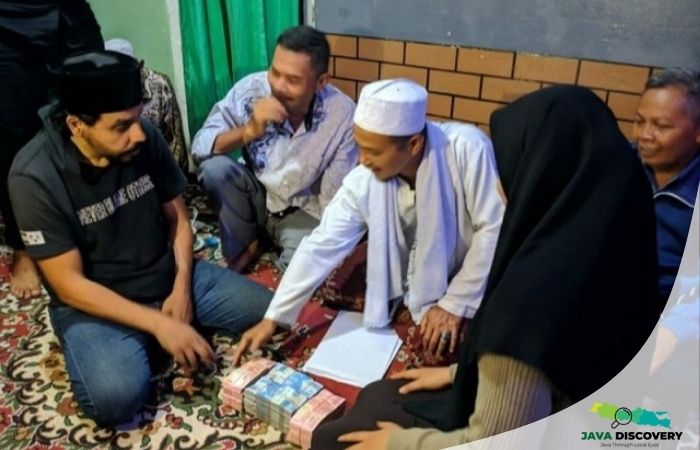
According to community elders in Desa Tugu Utara, the first recorded kawin kontrak occurred around 1987. The arrangement mimicked legitimate Islamic marriage—a wali, two witnesses, a cleric—but often without state registration. The duration was agreed in advance: a week, a month, sometimes just a few nights. When the time expired, the “husband” left, leaving behind a small dowry and, occasionally, a pregnancy.
“He was polite, he gave me money and a necklace,” recalled Lina, now 47, who once participated in a contract marriage at 19. “He said, ‘I will send you letters.’ But the letters never came.” Her story, published in a 2019 local study, mirrors dozens of similar testimonies collected in Cisarua and Cianjur.
What began as a handful of cases became an open secret by the 1990s. Entire neighborhoods near Warung Kaleng and Kampung Arab adapted. Arabic menus appeared. Rental villas added prayer mats. Local drivers learned to negotiate in Arabic. And quietly, brokers—some ex-guides, some former hotel staff—linked tourists with women from nearby towns.
Faith, Law, and the Façade of Sanctity
On paper, Indonesia’s 1974 Marriage Law allows only officially registered unions. Yet kawin kontrak found its loophole in religious interpretation. A handful of self-styled ustaz performed “instant weddings” for a fee, declaring the unions valid under Islam, though unrecorded by the state.
Local religious officials at the Cisarua Office of Religious Affairs repeatedly condemned the practice. “It’s not marriage, it’s deception,” said one cleric interviewed by Republika in 2024. “They use God’s name to justify lust.” Still, enforcement proved tricky: without formal registration, there was technically no crime—until trafficking or coercion could be proven.
The grey zone made Puncak’s contract marriages hard to police and harder to end. Each participant could claim moral cover: the man as a husband, the woman as a wife, the broker as a matchmaker, the cleric as a witness. “It’s a moral economy wrapped in religion,” noted anthropologist R. Wahyudi. “Everyone feels innocent because the transaction speaks the language of piety.”
Economy of Desire
Behind the ritual lies raw economics. Many women drawn into the system were young, divorced, or widowed—often migrants from Sukabumi, Cianjur, or Garut. “When factories closed, Puncak became the fallback,” said Nana Sutisna, a former local official. “Some did it once, others turned it into livelihood. The money could feed families for months.”
For Arab tourists—mostly from Saudi Arabia, Yemen, and Oman—the appeal was both cultural and practical. Temporary marriage, or mut’ah, is permissible in certain Islamic traditions. In Puncak, the practice took on its own hybrid form—part religious, part recreational. Villas became secluded sanctuaries; brokers handled introductions, translators, and payments. By the late 1990s, “contract marriage” had become a quiet industry.
Law and Crackdown
Government responses swung between denial and crackdown. Periodic police raids made headlines but rarely ended the trade. In 2013, local authorities arrested two brokers and suspended several clerics accused of facilitating illegal marriages. Yet the following year, journalists easily found new brokers operating under fresh numbers.
Officials launched social campaigns under slogans like “Puncak Bersih dari Kawin Kontrak” (“Clean Puncak from Contract Marriage”). Billboards appeared; sermons warned against exploitation. But the problem persisted underground. As one police officer admitted anonymously, “We can close the villas, but not the intentions.”
Women Left Behind
The human toll is rarely discussed. In Cianjur and Bogor, social workers encounter women raising children whose fathers vanished abroad. Without legal marriage certificates, they cannot claim child support or citizenship rights. “Some children carry Arab features but no documents,” said Dewi Anjarsari, an NGO worker. “We help them get identity cards, but the stigma follows them forever.”
For the women, shame intertwines with resignation. “I don’t regret feeding my mother,” said Siti, 34, in a 2023 field interview. “But I regret believing it was marriage.” She now sells snacks to tourists on the same road where her villa once stood.
The Pandemic Pause—and Return
When the COVID-19 pandemic struck in 2020, international tourism collapsed. For the first time in decades, the hills of Puncak fell silent. The villas emptied; the whispers stopped. Local authorities hoped the hiatus would end the practice. “There was no tourist, no contract, no marriage,” said one Cisarua community head.
But as borders reopened, the pattern began to resurface. A Republika investigation in mid-2024 revealed renewed activity, though more discreet. Deals now move through encrypted apps, and meetings happen in private rentals rather than public villas. “It’s smaller, but smarter,” said a local journalist. “The old network has gone digital.”
A Society in Conflict
Public opinion in Puncak remains divided. Some residents call for strict enforcement; others quietly defend it as a matter of consent. “Who are we to judge?” asked Pak Amin, a villa caretaker. “If two adults agree and no one is harmed, why not? Life is expensive.” Such pragmatism clashes with moral outrage from religious groups, who see kawin kontrak as a stain on national dignity.
For women’s advocates, the issue is larger than sex. It reflects the chronic absence of protection for informal labor. “We must stop pretending morality solves poverty,” said Prof. Lies Marcoes of UIN Jakarta. “As long as there is economic inequality and gendered dependency, the trade in intimacy will find new forms.”
Echoes of an Unfinished Story
In the early morning, when fog drifts over the tea plantations and the call to prayer echoes from the hills, the villas of Puncak look serene—almost innocent. But behind closed doors, echoes of past transactions still linger. Though the word “contract” has grown taboo, locals admit the practice never vanished. It simply learned to hide.
“Now it’s not called kawin kontrak,” said a 62-year-old driver who has worked the route for decades. “They call it ‘temporary companion.’ The paperwork is gone, the meaning is the same.”
Four decades since its quiet birth, Puncak’s contract marriages reveal more than moral failure—they expose the fragility of survival in a landscape where faith meets capitalism. Between mist and morality, between law and love, lies a story Java still struggles to tell aloud.
Category: History
Writer: Rizky Ananta