Sedekah Bumi Majalengka Gratitude Community and Rice Season

javadiscovery.com – In the soft, humid light before the monsoon fully settles over West Java, an entire village threads itself together with rice straw, vegetable stalks, and laughter. This is Sedekah Bumi in Sumber Wetan — not a performance of the supernatural, but a ritual of thanks, of shared plates, and of the steady work that binds neighbors before they return to their fields.
Walk with the procession: color and sound through a village
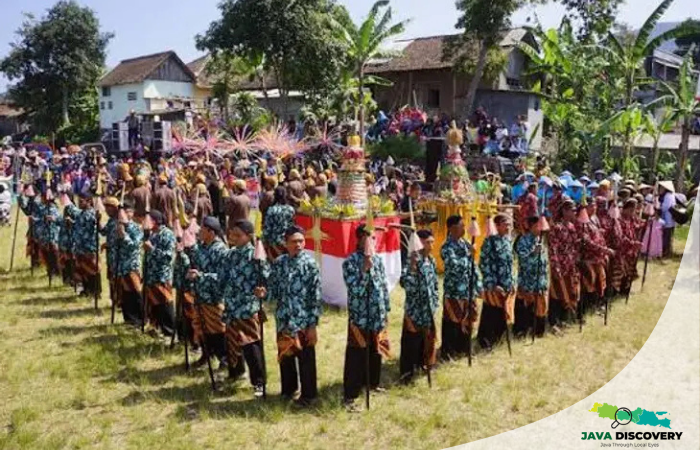
On the morning of October 29, 2025, hundreds of people from Desa Sumber Wetan gathered under a sky the color of pale steel. The village streets became a slow river of cloth and boots: women in sarongs carrying woven baskets, men balancing wooden poles, children clinging to ankles or perched on shoulders. Gunungan—tall conical piles of produce—were carried with solemn playfulness, their sides spilling with chilies, eggplants, sweet potatoes, bananas, and bundles of leafy greens that glinted with dew.
The procession moved with the rhythm of conversation. Voices overlapped: the low jokes of men who have worked the same land for decades, the higher, sing-song calls of women organizing the tumpeng and plates, the excited squeals of children who chase each other between offerings. The smell that rose from the column was earthy and sharp—wet soil, fresh greens, the faint smokiness of charcoal fires still burning in kitchen yards.

Ogo-ogo and the owl motif
Amid the harvest—the gunungan and tumpeng—there were ogo-ogo in the shape of a bird, specified by villagers as an owl. Onlookers might look for mysticism; instead, the animal reads as a practical emblem. As Kepala Desa Usi Sanusi explains, the owl represents a familiar ally in the fields: “Burung hantu adalah hewan pembasmi hama tikus, musuh utama para petani. Karena itu kami menjadikannya simbol dalam Sedekah Bumi, sebagai bentuk penghargaan kepada alam dan keseimbangan ekosistem pertanian,” she said.
“Owls eat the rats that damage the rice,” Usi told reporters. “We make them a symbol to honor nature’s balance.”
From village lane to wet field: a communal ritual of preparation
The procession does not end in the square. It pushes on until it reaches the paddies themselves—flat mirror-lands of wet soil—where the community forms a line and faces the offerings. Here the ceremony shifts from a parade to a congregation. Men remove their caps and sit cross-legged. Women arrange the tumpeng, the conical rice dish, at the edge of a small embankment. Prayers rise; voices settle; a calm like the surface of still water descends.
The ritual is timed before the next season of planting, a way to mark the transition from harvest to sowing. It is not only symbolic. The day also functions as a practical re-affirmation of relationships: who will be available for mutual labor, which irrigation channels need care, which elders will advise on seed selection. It is a living meeting of social logistics and gratitude.
Communal prayer, shared meal
The prayer itself is brief and communal—words offered for safety, for protection from pests, for blessing on the seedlings that will soon be planted. After that, plates are passed and the community eats together in the wet field. Bowls clink, spoons scrape, and the sounds of chewing mingle with distant calls of cattle and the whisper of wind across banana leaves.
“Alhamdulillah, bisa dapat banyak sayur dan buah. Sebagian untuk dimasak di rumah, sebagian lagi saya bagikan ke tetangga. Tradisi ini bikin warga makin rukun dan bersyukur,” Roeti, a local villager, said with a grin. She described taking home produce for her family and also for neighbors, a small circulating economy of gifts.
The scramble for the gunungan: blessing through sharing
The most animated moment arrives when the formalities conclude and the gunungan are offered to the crowd. People form long lines across the paddies and, in synchrony, reach for the produce. It is a game and a blessing: the belief—held in many parts of Java—that the produce taken from the gunungan carries good fortune for the coming year. The scramble is exuberant, communal. Hands blur, laughter rings, someone inevitably trips and is helped to their feet.
But beneath the play is a serious ethic: redistribution. Families who cannot afford certain vegetables may walk away with a sack of greens; elders may receive fruit for medication or comfort. The physical act of taking is also an act of sharing, because much of what is gathered will be divided, cooked, and redistributed once more.
A ritual misread as mysticism
Outsiders sometimes label Sedekah Bumi as mystical. In Sumber Wetan, the villagers quietly reject that frame. One man, Waskana, explained that the essence of the ritual is gratitude and social cohesion rather than magic. “Sebetulnya hakikatnya adalah syukuran, bersyukur dengan cara berbagi bersama dan silaturahmi berjamaah di antara warga,” he said. The ritual is an inheritance, he added—an older generation’s social technology to ensure people eat and work together.
Gotong royong: mutual aid beyond ceremony
The word gotong royong—mutual labor and mutual help—circles every description of the day. Sedekah Bumi functions as an annual calibration of the village’s cooperative muscles. When the sluice gates must be cleared, when terraces are mended after rain, and when seedlings must be transplanted in the rice fields, the names of those who pledged time and labor at Sedekah Bumi are the ones called first. The event is as much about relaying commitments as it is about blessing harvests.
In practical terms, the village has also seen infrastructural changes that feed hope. Usi Sanusi noted the recently repaired irrigation from Bendungan Rentang, which now holds more water and promises better distribution. In a place where rainfall varies and small streams can dictate the success of a season, such improvements give tangible reason for optimism.
Resilience in the face of change
The ritual thus folds the immediate and the long-term together: a festival of thanks and a meeting of practical concerns. Younger villagers, many of whom commute to towns or balance off-farm work, still attend. For them Sedekah Bumi is a connection to land memory—a living archive of how the village organizes care for water, soil, and one another.
Voices from the field
The voices of Sumber Wetan are candid. They speak plainly about pests and price fluctuations, about seedlings and market days, about the patience required to coax a season into abundance. Roeti’s grin hides the calculation of a household budget. Waskana’s insistence against mysticism is also an insistence on dignity: that gratitude should not be reduced to superstition when it is, in fact, a mechanism for mutual support.
“Dengan bersyukur ini, kan insya Allah bisa melapangkan rezeki. Apalagi, acara ini dilakukan sebelum memulai masa tanam, jadi tidak ada salahnya jika dilakukan acara syukuran,” a villager explained—emphasizing that gratitude and shared ritual precede the hard work of planting.
The ritual also leaves room for joy. Children dart through the procession, someone brings a radio that plays an old dangdut tune, and neighbors trade small jokes as they re-tie rope and rebalance baskets. Such levity is not incidental; it lubricates the social fabric, making the heavier obligations of labor and maintenance easier to sustain.
Reading the ritual: ecology, economy, and social repair
Viewed from the perspective of an ethnographer or an agronomist, Sedekah Bumi is adaptive. It harmonizes environmental knowledge—knowing where owls hunt and where rats gnaw—with economic care, a sharing economy that mitigates scarcity. It is also a form of social repair, a ritual that resets obligations and renews trust.
Rituals like this cannot be reduced to quaintness. They are, in the language of resilience studies, social capital: practical, transferable, and worth protecting. When irrigation improves and yields rise, those gains are amplified by the social networks that ensure cooperation; when seasons are lean, those same networks distribute risk and food so that no single household becomes untethered.
At dusk: the field cools, promises fold into plans
By late afternoon the paddies had been turned back into work sites. The tumpeng had been mostly eaten; leftover greens were bundled and slipped from hand to hand. People drifted back down village lanes, damp cloths around necks, small sacks of vegetables for the evening meal. Conversation shifted from prayer to schedule. Who would watch the seedlings? Who would help with the irrigation next week?
The ritual—so bright and ceremonial earlier—dissolved into planning and practicalities. Its power is less in spectacle than in this quiet reorganization: agreements renewed, tasks distributed, gratitude expressed and then translated into work. If there is any magic, it is the human kind—the discipline of people choosing to keep their promises to one another.
Source note: Reporting in this piece draws on local accounts reported from Desa Sumber Wetan, Kecamatan Jatijujuh, Kabupaten Majalengka on October 29, 2025, and on interviews with village figures including Kepala Desa Usi Sanusi and residents Roeti and Waskana. (Local coverage appeared in Pikiran Rakyat Jabar.)