
Fireflies and the Disappearing Night Sky in Rural Java

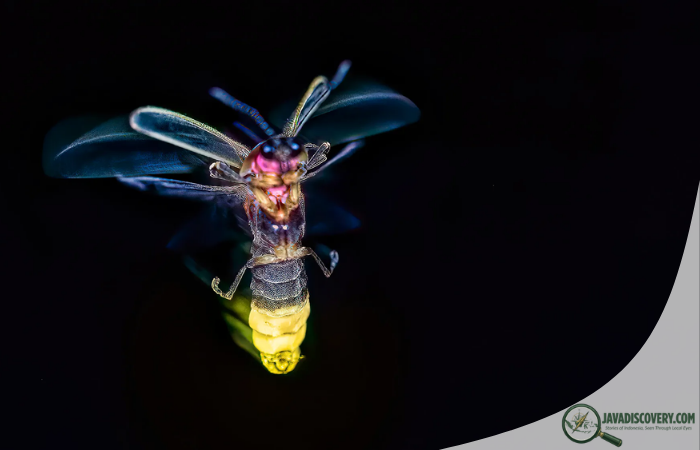
javadiscovery.com – On certain nights in rural Java, when the air is still and humidity hangs low over the fields, small points of light begin to flicker above the grass. At first they appear scattered, almost random. Then, slowly, patterns emerge. A pulse here, a glow there, moving in quiet arcs through the darkness. These are fireflies, or kunang-kunang, their light soft and fleeting, yet unmistakable.
For generations, these insects have been part of the night landscape. Children once chased them along riverbanks, their laughter blending with the steady chorus of crickets. Farmers walking home after dusk would notice their glow along irrigation canals, marking the edges of fields with gentle movement. Fireflies were not rare. They were expected.
Today, in many places, that expectation has faded. The night sky itself is changing, and with it, the delicate presence of these luminous insects.

The Biology of Light
Fireflies produce light through a chemical reaction known as bioluminescence. Within their bodies, a compound called luciferin reacts with oxygen, releasing energy in the form of visible light.
This light is not constant. It appears in pulses, each species producing distinct patterns of flashes.
These patterns serve a crucial purpose. They are signals used in mating, allowing individuals to locate one another in the dark.
Each rhythm carries meaning. A specific interval between flashes, a particular brightness, a defined height above the ground. Together, these elements form a language of light.
Habitats of Stillness and Moisture
In Java, fireflies are most commonly found in environments where moisture is abundant and disturbance is minimal.
Rice paddies, riverbanks, and areas with dense vegetation provide ideal conditions. These habitats support the insects’ life cycle, offering both food and shelter.
Larvae often live in damp soil or near water, feeding on small invertebrates such as snails and worms.
The presence of fireflies therefore reflects a balanced ecosystem. Clean water, stable vegetation, and low levels of pollution are all essential.
The Night Sky as a Background
Fireflies depend not only on their immediate environment but also on the quality of darkness itself.
Their light signals are subtle. To be effective, they require contrast against a dark background.
In the past, rural Java offered such conditions. Nights were illuminated only by moonlight and stars. The sky stretched wide and clear, providing a natural canvas against which firefly flashes could be seen.
This darkness allowed their communication to function efficiently.
The Spread of Artificial Light
In recent decades, artificial lighting has expanded into rural areas. Electric lights now line roads, illuminate homes, and extend activity into the night.
While these changes bring convenience and safety, they also alter the nocturnal environment.
Light pollution reduces the contrast between firefly signals and their surroundings. Their flashes become harder to detect, both for human observers and for other fireflies.
This interference disrupts mating patterns, making it more difficult for populations to sustain themselves.
Declining Populations
In many parts of Java, firefly populations have decreased. The reasons are complex and interconnected.
Habitat loss plays a significant role. Conversion of wetlands into agricultural or residential land reduces the areas where fireflies can live and reproduce.
Water pollution affects larvae, which depend on clean, oxygen-rich environments.
The use of pesticides reduces the availability of prey and introduces toxins into the ecosystem.
Combined with increasing light pollution, these factors create conditions that are difficult for fireflies to survive.
Cultural Memory of Light
The decline of fireflies is not only an ecological issue. It is also a cultural one.
For many in rural Java, memories of childhood include nights filled with moving points of light. These experiences shaped a sense of connection to the natural world.
Stories, songs, and everyday conversations once referenced fireflies as familiar elements of the landscape.
As their presence diminishes, so too does a part of that shared memory.
The Disappearing Stars
Alongside the loss of fireflies, the night sky itself is becoming less visible. Artificial lighting obscures stars, reducing the clarity of the sky.
In areas where lights are brightest, only a few stars remain visible. The dense patterns once seen across the sky fade into a faint background.
This change affects not only aesthetic experience but also ecological processes. Many species rely on natural light cycles for navigation and behavior.
The disappearance of darkness alters these patterns in ways that are still being understood.
Ecological Connections
Fireflies are part of a broader network of nocturnal life. Their decline can indicate wider changes within ecosystems.
Because they depend on specific environmental conditions, their presence or absence reflects the health of their surroundings.
In this sense, fireflies act as indicators, signaling shifts that may not be immediately visible.
Moments That Remain
Despite these challenges, fireflies have not disappeared entirely. In certain areas where conditions remain favorable, they continue to glow.
These places are often quiet and less disturbed. Fields away from major roads, riverbanks with minimal artificial light, pockets of vegetation that have been left intact.
In these environments, the old patterns persist. Light flickers gently, rising and falling in the dark.
A Fragile Visibility
Watching fireflies requires patience. Their light is subtle, their movement unpredictable.
It is an experience that cannot be rushed or controlled. It depends on being present in the right place, at the right time, under the right conditions.
This fragility is part of what makes their presence meaningful.
Light Within Darkness
Standing at the edge of a field on a quiet night, it is possible to see both absence and presence at once. The sky above may hold fewer stars than before. The darkness may feel thinner, interrupted by distant lights.
Yet in the grass below, a small glow appears. Then another. And another.
Fireflies continue to signal, their language of light unfolding despite the changes around them.
In rural Java, they remain reminders of a relationship between darkness and life. A relationship where light does not overwhelm, but emerges gently, carrying meaning through the night.
As the landscape evolves, their presence becomes more than a natural phenomenon. It becomes a measure of what is being lost, and what still endures in the quiet spaces where darkness remains.