The Anatomy of the Javanese Axe: Traditional Woodworking and Forestry Tools

javadiscovery.com – In the dense, humid teak forests of Central Java, the anatomy of the Javanese axe begins with the selection of a “kayu keras” (hardwood) handle, curved to fit the palm with a precision that only generations of “tukang kayu” (carpenters) can master. To the Javanese, the axe is not merely a blunt instrument of destruction; it is a “piranti” (tool) of transformation, essential for “babad alas” (clearing the forest) and the construction of the sacred “joglo” home. The anatomy of the Javanese axe is characterized by its “luwes” (flexible) design, often featuring a hand-forged steel head wedged into a split wooden haft and secured with “tali ijuk” or rattan. Unlike the heavy, symmetrical felling axes of the West, the Javanese “pethel” and “wadung” are asymmetrical masterpieces of “ergonomi” (ergonomics), designed for the specific density of tropical hardwoods. The anatomy of the Javanese axe reflects the island’s “budaya” (culture) of “ketelatenan” (meticulousness), where every strike is a rhythmic dialogue between the steel and the grain. In a landscape where the “alas” (forest) is seen as a living entity, the axe is the bridge between the raw power of nature and the refined “alus” (refined) world of human civilization, providing the “bahan” (material) for the shelters and “ukiran” (carvings) that define Javanese identity.
The Pethel: The Small Giant of Woodworking
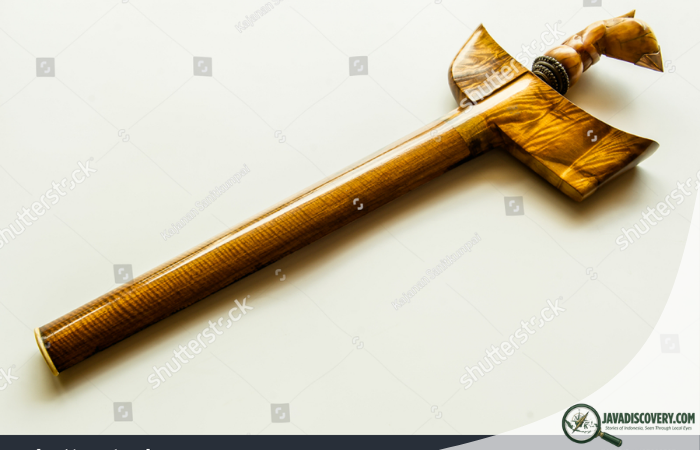
To understand the local reliance on the anatomy of the Javanese axe, one must first look at the “pethel.” This small, adze-like tool is the most versatile instrument in the Javanese woodworker’s “kotak piranti” (toolbox). The anatomy of the Javanese axe in the form of the pethel features a blade set perpendicular to the handle. This allows the artisan to “planer” (plane) the surface of a “saka” (pillar) or hollow out a “lesung” (rice mortar) with surgical precision. The pethel is an extension of the “jiwa” (soul) of the carpenter; it does not just chop, it “shapes” the wood with a delicate “roso” (feeling) that a modern electric planer can never replicate.
The handle of the pethel is typically made from “kayu sonokeling” or “asam jawa” (tamarind wood), chosen for its ability to absorb the “getaran” (vibration) of the strike. This is a critical part of the anatomy of the Javanese axe, as it prevents the artisan’s hand from becoming “kesemutan” (numb) during long hours of labor. The blade itself is often made from “baja per” (recycled leaf spring steel), forged by a village “pandhe besi” (blacksmith) who understands the “temper” required for Javanese timber. The pethel is a tool of “kemandirian” (self-reliance), often passed down from father to son as a “pusaka” (heirloom) of the craft, its handle worn smooth and dark by the “keringat” (sweat) of generations.

Local voices in the furniture hubs of Jepara describe the pethel as the “nyawa” (life) of the workshop. An elderly carver, his eyes still sharp despite his years, explains that the anatomy of the Javanese axe allows for “ngetok” (precise cutting) in tight corners where larger tools would fail. The pethel represents the Javanese value of “setiti”—being careful and thrifty with one’s effort and materials. With a pethel, no wood is wasted; every chip is a deliberate step toward the final “wujud” (form). It is the tool that turns a “batang kayu” (log) into a “karya seni” (work of art).
The Wadung: The Heavy Heart of the Forest
While the pethel is for refinement, the “wadung” represents the “kekuatan” (strength) within the anatomy of the Javanese axe. The wadung is a larger, heavier felling axe used for the initial “tebang” (felling) and “belah” (splitting) of logs. Its anatomy is distinct, often featuring a “kapak” (axe) head that is narrower and thicker than European counterparts, designed to penetrate the incredibly “ulet” (tough) fibers of seasoned teak or mahogany. The anatomy of the Javanese axe in the wadung version relies on “momentum” and the “bobot” (weight) of the steel to do the work, requiring a “mantap” (steady) swing from the “pundhak” (shoulders).
In rural Java, the wadung is a symbol of “kejantanan” (masculinity) and the “juang” (struggle) of the pioneer. Before a forest is cleared for a new “desa” (village), a “selamatan” (ritual feast) is often held, and the wadung is “dijamani” (ritually cleansed) to ensure it does not strike “batu” (stone) or cause “kecelakaan” (accidents). The anatomy of the Javanese axe is thus intertwined with “mitologi” (mythology); the tool is believed to have a “penunggu” (guardian spirit) that must be respected. A wadung that “mangan” (eats/bites) the wood easily is seen as a sign of “berkah” (blessing), showing that the forest “ikhlas” (consents) to being harvested for human use.
The “gagang” (handle) of the wadung is significantly longer than that of the pethel, providing the “ungkit” (leverage) needed for heavy tasks. It is often reinforced at the “leher” (neck) with “simpai” (metal or rattan bands) to prevent the wood from splitting under the “tekanan” (pressure) of a heavy impact. This structural reinforcement is a key element in the anatomy of the Javanese axe, demonstrating the “kecerdasan” (intelligence) of village blacksmiths who had to solve mechanical problems using only “bahan alam” (natural materials). The wadung is the “pembuka jalan” (path-clearer), the tool that makes all other Javanese crafts possible by providing the raw “kayu” (wood).
The Pandhe Besi: Forging the Steel Soul
The anatomy of the Javanese axe cannot be discussed without acknowledging the “pandhe besi” or village blacksmith. The “besi” (iron) used in these axes is often a “paduan” (alloy) of local scrap and high-carbon steel, folded and hammered in a process reminiscent of “keris” making. The “sepuhan” (tempering) is the most guarded secret of the pandhe. By plunging the glowing red steel into a specific “bak air” (water tank) or oil, the smith determines the “kekerasan” (hardness) of the edge. The anatomy of the Javanese axe is perfected in these “perapen” (foundries), where the “geni” (fire) and “palu” (hammer) give the tool its “tajam” (sharpness).
A Javanese axe head is rarely a single piece of uniform metal. Instead, the anatomy of the Javanese axe often involves “laminasi” (lamination), where a hard steel “baja” (core) is sandwiched between tougher, more flexible iron “kulit” (skins). This ensures that the axe stays “landhep” (sharp) for a long time but will not “patah” (snap) when hitting a hard “galih” (heartwood) knot. This “dualitas” (duality) of the material—hard yet flexible—is a core Javanese philosophy, reflecting the ideal of a person who is “tegas” (firm) in principle but “luwes” (adaptable) in social life.
The “lubang” (eye) of the axe head where the handle is inserted is also a vital part of the anatomy of the Javanese axe. It is often “dibuat lonjong” (made oval) rather than round to prevent the head from “muter” (spinning) during use. The “wedging” process uses “pasak” (small wooden wedges) driven into the top of the haft, which are then soaked in “air” (water) to expand and create a permanent, “kenceng” (tight) bond. This reliance on the natural “sifat” (properties) of wood and moisture is the “teknologi” (technology) of the village, a sustainable and repairable system that has stood the test of “abad” (centuries).
The Evolution of the Handle: Ergonomics of the Soil
The “gagang” (handle) is perhaps the most “personal” part of the anatomy of the Javanese axe. Unlike factory-made tools with generic handles, a traditional Javanese axe handle is “dirajut” (tailored) to the specific “jangkauan” (reach) and “genggaman” (grip) of the owner. The curve of the handle is not for “hiasan” (decoration); it is designed to shift the “titik berat” (center of gravity) forward, increasing the “tenaga” (power) of the swing without requiring extra “otot” (muscle). This “efisiensi” (efficiency) is a hallmark of the anatomy of the Javanese axe.
In the “pegunungan” (mountains), handles are often left “kasar” (rough-textured) to provide a “pakem” (firm) grip even when the hands are “basah” (wet) with rain or “keringat” (sweat). In the “bengkel” (workshop), however, the anatomy of the Javanese axe handles may be “diamplas” (sanded) and oiled with “minyak kelapa” (coconut oil) to prevent “kapalan” (blisters). The choice of “serat kayu” (wood grain) is also paramount; the grain must run the full “panjang” (length) of the handle to prevent it from “sempal” (breaking) under “beban” (load). This “kearifan lokal” (local wisdom) ensures that the tool is both a “kanca” (friend) and a “pelindung” (protector) to the worker.
The anatomy of the Javanese axe also accounts for “perawatan” (maintenance). Because the handle is made of “bahan organik” (organic material), it must be “dipepe” (sun-dried) or kept in a “kering” (dry) place to prevent “jamur” (fungus). The relationship between the “manusia” (human) and the “kapak” (axe) is one of “resiprokal” (reciprocity); if the person takes care of the tool, the tool will take care of the person’s “panguripan” (livelihood). This “etika” (ethic) of tool-keeping is a fading but vital part of the “pedesaan” (rural) Javanese culture, where an axe is never “dibuang” (thrown away), only “diganti” (replaced) piece by piece.
Spiritual Symbolism: The Axe as a Cleanser
Beyond its “fungsi” (function), the anatomy of the Javanese axe holds a “simbolis” (symbolic) place in the “kosmologi” (cosmology). The act of “mbabad” (clearing) is seen as a spiritual cleansing of “hawa nafsu” (lowly desires). In many Javanese “dongeng” (folklore), the hero uses an axe to clear a “hutan angker” (haunted forest) to build a “kerajaan” (kingdom), symbolizing the “kemenangan” (victory) of “tata” (order) over “chaos.” The anatomy of the Javanese axe is thus the anatomy of “peradaban” (civilization) itself.
The “tajam” (sharpness) of the axe is often equated with the “tajam” of the “pikiran” (mind). A “kapak tumpul” (dull axe) is a sign of a “malas” (lazy) spirit. Therefore, the “asah” (sharpening) of the axe on a “watu asah” (whetstone) is a ritual of “refleksi” (reflection). As the steel is honed, the woodworker also “hones” his “niat” (intention) for the day’s work. The anatomy of the Javanese axe provides the “sarana” (medium) for this “meditasi” (meditation), turning a “pekerjaan kasar” (manual labor) into a “laku” (spiritual discipline).
In some “kejawen” (Javanese spiritualism) traditions, a small “kapak” pendant is worn as a “jimat” (talisman) to “memotong” (cut through) “rintangan” (obstacles) and “penyakit” (disease). The anatomy of the Javanese axe—specifically the “pertemuan” (meeting) of the hard steel and the flexible wood—is seen as a “perlambang” (symbol) of the “manunggal” (unity) of the “langit” (heaven) and “bumi” (earth). The axe is the “kilat” (lightning) that strikes the “pohon” (tree), bringing the “api” (fire) of “transformasi” (transformation) to the world of men.
Conclusion: The Enduring Edge of Tradition
The anatomy of the Javanese axe is a testament to a “budaya” (culture) that refuses to see “teknologi” (technology) as something separate from “jiwa” (soul). From the “pandhe besi’s” forge to the “tukang kayu’s” calloused hands, the axe remains a “jembatan” (bridge) between the “alam” (nature) and the “rumah” (home). It is a tool designed with “kawicaksanan” (wisdom), “kesehatan” (health), and “keindahan” (beauty) in mind. While modern “gergaji mesin” (chainsaws) may be faster, they lack the “kealusan” (refinement) and the “spiritualitas” (spirituality) inherent in the anatomy of the Javanese axe.
As the “surya” (sun) sets over the “hutan jati” (teak forest), and the “tukang” hangs his “pethel” on the wall of his “pawon” (kitchen), the anatomy of the Javanese axe continues to hold the “sejarah” (history) of the island. It is a history written in “serpihan kayu” (wood chips) and “keringat” (sweat), a story of a people who know how to “menaklukkan” (conquer) the wilderness without “merusak” (destroying) its “nyawa.” As long as the “jati” grows and the “pandhe” hammers, the anatomy of the Javanese axe will remain the “pondasi” (foundation) of the “pedesaan” (rural) life, a sharp and “abadi” (eternal) reminder of the power of the human hand guided by the “batin” (inner heart).