Spiritual Landscapes Beyond Java Across the Archipelago

javadiscovery.com – The morning sun breaks over the jagged peaks of the Barisan Mountains in Sumatra, casting long, sharp shadows across the deep turquoise waters of Lake Toba. While the volcanic heart of Java is often seen as the epicenter of Indonesian mysticism, a journey into the spiritual landscapes beyond Java reveals a nation where the earth itself is a sacred manuscript. In these outer reaches, spirituality is not confined to the silent stone of ancient temples; it is a living, breathing force found in the rustle of primary rainforests, the cold depths of crater lakes, and the sun-bleached savannahs where ancestors are believed to ride on the wind. Spiritual landscapes beyond Java offer a window into a world where the veil between the physical and the supernatural is remarkably thin. From the megalithic tombs of Sumba to the limestone cliffs of Sulawesi, the role of the environment is not merely a backdrop but an active participant in the divine order. To explore these spiritual landscapes beyond Java is to witness the enduring power of “Adat” and the resilient harmony between humans and the unseen powers that govern the mountains and seas. It is a journey that transcends modern maps, leading the traveler into the ancient soul of the Nusantara, where every rock, tree, and wave carries a name and a prayer.
The Marapu of Sumba: Stones of the Golden Savannah
In the arid, golden interior of Sumba, the spiritual landscapes beyond Java take on a form that feels frozen in time. Here, the landscape is dominated by massive limestone megaliths that stand as silent guardians over the villages. This is the realm of the Marapu, the ancestral religion that dictates every facet of Sumbanese life. For the people of Sumba, the physical world is a mirror of a higher, celestial realm, and the “home” is a sanctuary designed to bridge the two. The soaring roofs of their traditional houses, which peak into the sky like sharpened spears, are meant to provide a landing place for the spirits as they descend from the heavens.
The spiritual landscapes beyond Java in Sumba are also defined by the sacredness of the soil. During the annual Pasola festival, the earth is literally watered with the blood of horses and warriors in a ritual spear fight. This is not an act of violence, but a sacred sacrifice intended to ensure a fertile harvest. The Sumbanese believe that the “Marapu” reside in specific trees, springs, and stones, and to disturb these without the proper ritual is to invite calamity. In this dry landscape, spirituality is a matter of survival, a constant negotiation with the spirits of the ancestors who demand respect and blood in exchange for the life giving rain.

The Sacred Axis of Bali: Mount Agung and the Sea
While Bali is Java’s closest neighbor, its spiritual landscapes beyond Java are unique in their “Kaja Kelod” orientation. For the Balinese, the universe is organized along a sacred axis between the mountains (Kaja) and the sea (Kelod). Mount Agung, the towering stratovolcano that dominates the island’s skyline, is seen as the “Navel of the World,” the dwelling place of the gods. Every temple on the island, no matter how small, is oriented toward this peak. To look toward the mountain is to look toward purity, while the sea is the realm of dissolution and the spirits of the underworld.
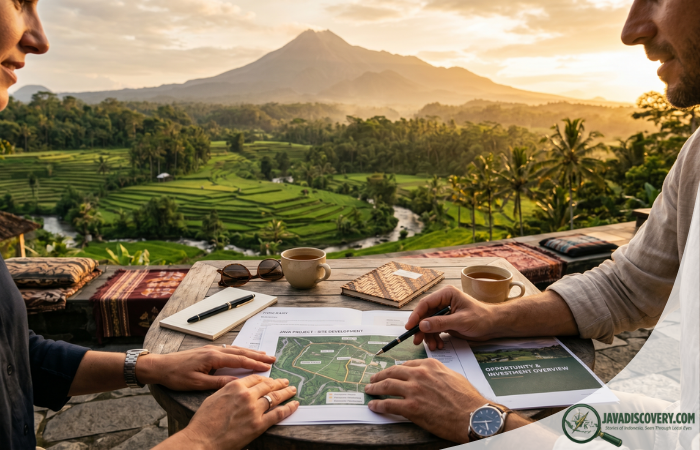
This spiritual landscape is meticulously maintained through the “Subak” system, a communal irrigation network that treats water as a holy gift from the goddess Dewi Danu. The water flows from the crater lakes down through the terraced rice fields, blessed at every junction by small shrines. In the context of spiritual landscapes beyond Java, Bali represents the most sophisticated integration of agriculture and divinity. The landscape is a living altar, where the scent of frangipani and incense is ever present, and the rhythmic sound of the “gamelan” serves to harmonize the community with the mountain’s volatile energy. Here, the land is not owned; it is borrowed from the gods and must be returned through constant ritual and beauty.
The Hidden Spirits of the Dayak Rainforest
Deep within the ancient rainforests of Kalimantan, the spiritual landscapes beyond Java are found in the relationship between the Dayak people and the “Hutan,” the primary jungle. For the Dayak who follow the “Kaharingan” faith, the forest is a sentient being. The massive “Ulin” or ironwood trees are believed to be the ladders used by the spirits to move between the worlds. In these dense, humid landscapes, spirituality is found in the “Liau,” the spirit of the deceased that must be guided back to the upper world through the “Tiwah” ceremony.
Tana Toraja: The Land of the Heavenly Kings
In the rugged highlands of South Sulawesi, the spiritual landscapes beyond Java are etched into the very faces of the limestone cliffs. Tana Toraja is a place where death is the most vibrant part of life. The landscape is scattered with “Londa” and “Lemo,” ancient burial sites where wooden effigies known as “Tau-Tau” gaze out from hand carved balconies in the rock. These cliffs are not just cemeteries; they are the portals to “Puya,” the land of the spirits. The Torajans believe that the mountains are the physical manifestation of the first ancestors who descended from the stars on a celestial staircase.
Walking through the spiritual landscapes beyond Java in Toraja, one encounters the “Tongkonan,” the traditional houses with roofs that arc like great ships. These structures are always positioned to face the north, toward the source of life. The surrounding landscape, filled with jagged karst formations and emerald rice fields, is seen as a sacred map. Every buffalo sacrificed during the “Rambu Solo” funeral rituals is believed to carry the soul of the departed through the misty valleys toward the peaks of the afterlife. In Toraja, the landscape is a witness to the eternal continuity of the family, a place where the dead are never truly gone but remain as guardians of the mountain passes.
“The mountain does not speak, but it hears everything. We do not walk on this land as masters; we walk as children who must ask permission from the spirits of the stones and the water before we take a single step.” — Opa Lukas, 82, an Adat Elder in the Ngada Highlands.
Lake Toba: The Volcanic Cradle of the Batak
In North Sumatra, the spiritual landscapes beyond Java are defined by the immense, brooding presence of Lake Toba. As the largest volcanic lake in the world, Toba is more than a geographical wonder; it is the spiritual cradle of the Batak people. At the center of the lake lies Samosir Island, and rising above it is “Pusuk Buhit,” the sacred mountain where the Batak believe their first ancestor, “Si Raja Batak,” descended to earth. To the Batak, the lake is a sacred basin that holds the memory of their origins.
The spiritual landscapes beyond Java in this region are tied to the “Debata,” the supreme being, and the three realms of the universe. The Batak “Huta” or villages are built with a deep understanding of these cosmic layers. The traditional “Jabu” houses, with their high, saddle shaped roofs, are designed to resonate with the energy of the mountain. Even after the arrival of modern faiths, the landscape remains haunted by the “Begu,” the spirits of the ancestors that are believed to inhabit the banyan trees and the waterfalls. To visit Toba is to feel the weight of a landscape that was forged in a prehistoric explosion, a place where the power of the earth is so palpable that it demands a spiritual response from all who stand on its shores.
| Region | Sacred Landmark | Spiritual Essence |
|---|---|---|
| Bali | Mount Agung | The Kaja axis and the dwelling of the high gods. |
| Sumba | Limestone Megaliths | The Marapu spirits and ancestral connections to the earth. |
| North Sumatra | Lake Toba & Pusuk Buhit | The volcanic origin of the Batak and the cosmic layers. |
| South Sulawesi | Karst Cliffs of Toraja | Portals to the afterlife and the stars. |
| Kalimantan | Primary Rainforest | Sentient jungle spirits and the Kaharingan way. |
The Harmony of the Forbidden Forests
A fascinating element of spiritual landscapes beyond Java is the concept of “Hutan Larangan,” or forbidden forests. In regions like West Sumatra and Bali, certain groves are designated as off limits to human activity. These are not merely conservation zones in the modern sense; they are spiritual “safe houses” for the deities and forest spirits. In these spiritual landscapes beyond Java, the local “Adat” elders enforce strict prohibitions against cutting wood or hunting within these boundaries. To violate the “Hutan Larangan” is to risk spiritual sickness or village wide misfortune.
This indigenous environmentalism proves that the spiritual landscapes beyond Java are functioning ecosystems protected by faith. The “spirits” act as the ultimate forest rangers, ensuring that the water sources remain pure and the biodiversity of the islands is preserved. In the Mentawai Islands, for example, the “Sikerei” or shamans must ask permission from the spirits of every plant before it is harvested for medicine. This dialogue between the human and the botanical is the core of the spiritual landscapes beyond Java, where every leaf is seen as a vessel of “Arat Sabulungan,” the soul of all things. It is a philosophy that views the earth not as a resource, but as a relative.
The Sea as a Sacred Temple
For the maritime cultures of the archipelago, spiritual landscapes beyond Java extend far beneath the surface of the waves. The Bajau “Sea Nomads” and the Lamalera whale hunters of Lembata view the ocean as a sacred temple. In Lembata, the annual hunting of the sperm whale is preceded by intense prayer and the “Mebalangan” ritual to settle disputes within the village. They believe that the whale is a “gift” from the sea ancestors, sent only to those whose hearts are clean. The sea is not a chaotic void, but a structured spiritual domain with its own laws and guardians.
In the context of spiritual landscapes beyond Java, the “underwater world” is often seen as the home of the “Nyi Roro Kidul” equivalents or sea deities that must be appeased with offerings of rice, flowers, and incense. When the Bugis sailors embark on a long journey, they perform the “Barzanji” ritual to ensure the protection of the spirits of the wind and the currents. For these seafaring people, the horizon is a spiritual boundary, and the “landscape” of the sea is a map of divine presence. Spiritual landscapes beyond Java are therefore as much about the blue “void” as they are about the green mountains, showing a holistic view of a universe where water and land are equally sacred.
The Resilience of Indigenous Faith
The spiritual landscapes beyond Java have remained remarkably resilient despite centuries of external religious influence. Whether it is the integration of Catholic rituals into the megalithic traditions of Flores or the persistence of “Kaharingan” in Kalimantan, the “land” remains the ultimate authority. People may change the names they call God, but they rarely change the way they respect the mountain. This “syncretism” is a hallmark of spiritual landscapes beyond Java, where modern identity is built on top of an ancient, animist foundation.
In the modern era, these spiritual landscapes beyond Java are facing the dual threats of industrial mining and large scale palm oil plantations. When a sacred mountain is leveled for its ore or a forbidden forest is cleared for timber, it is not just an ecological loss; it is a spiritual amputation for the local community. The struggle to protect spiritual landscapes beyond Java is a struggle for the very “mana” or life force of the islands. Many indigenous groups are now using the language of “Human Rights” to protect what they have always known as “Sacred Rights,” proving that the ancient landscapes of the Nusantara continue to fight for their survival in the modern world.
Conclusion: The Eternal Echo of the Earth
Spiritual landscapes beyond Java reveal an Indonesia that is infinitely more complex and profound than what is seen in the coastal cities. It is a nation where the earth is the primary scripture, and the ancestors are the eternal guides. From the volcanic mists of North Sumatra to the coral reefs of the eastern seas, spiritual landscapes beyond Java remind us that humanity is but one small part of a vast, interconnected cosmic order. These landscapes are the “ruh” or the spirit of the archipelago, the invisible force that keeps the culture vibrant and the people resilient.
As the stars begin to shine over the high roofs of Sumba and the evening call to prayer echoes across the shores of Lake Toba, the spiritual landscapes beyond Java remain in a state of quiet, powerful vigil. They are the guardians of a wisdom that preceded modern nations and will likely outlast them. To walk through these landscapes is to be reminded of our own mortality and our profound responsibility to the land that sustains us. Spiritual landscapes beyond Java are not just places to visit; they are experiences that transform the “jiwa” or the soul, leaving the traveler with a deep sense of “syukur” or gratitude for the living, breathing mystery of the earth. In the end, the archipelago is a single, massive temple, and we are all merely guests within its hallowed halls, listening to the eternal echo of the earth that continues to guide our steps toward the sacred.